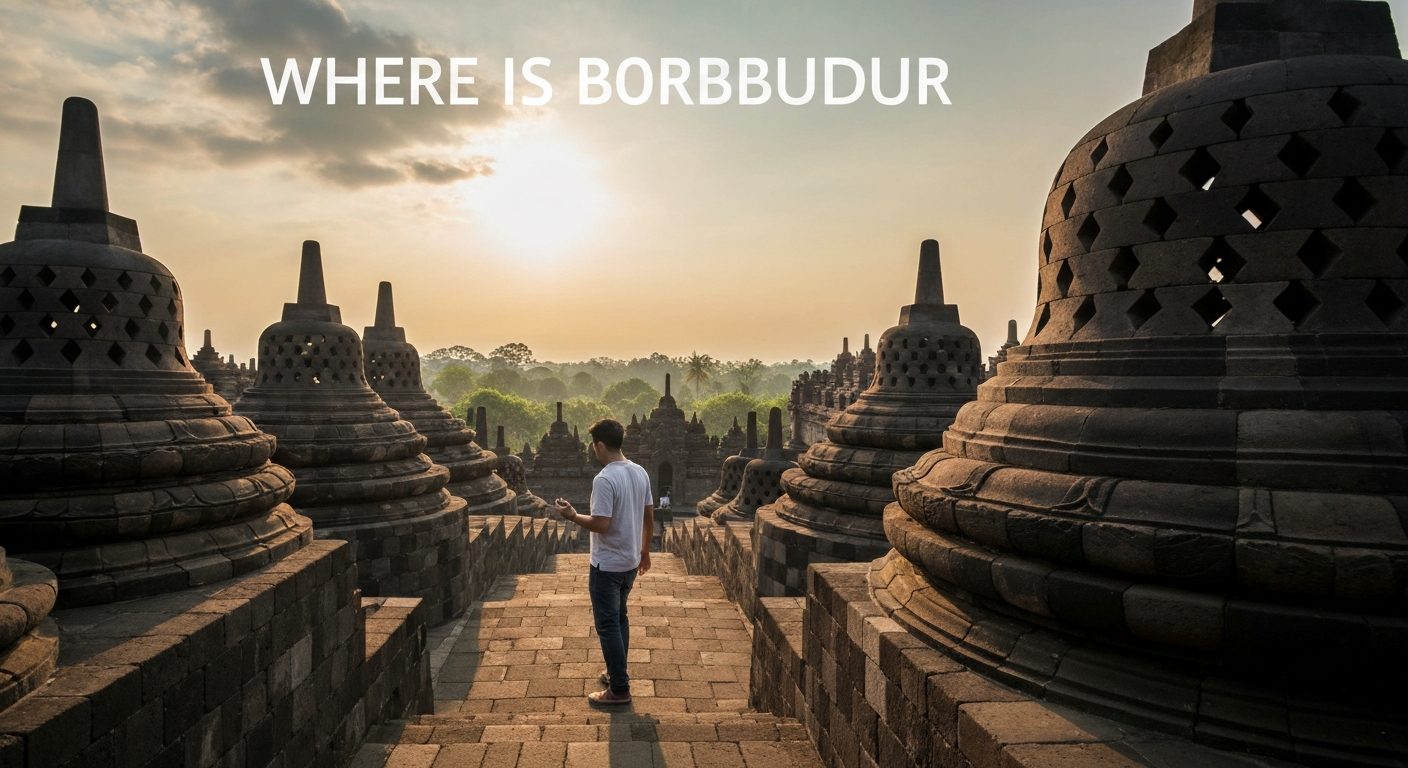
Borobudur sits prominently in Magelang Regency, Central Java, Indonesia. This colossal 9th-century Sailendra-era UNESCO World Heritage monument is the world’s largest Buddhist temple, positioned roughly 40 km northwest of Yogyakarta and approximately 86 km from Semarang.
Where is Borobudur? Pinpointing its Location on the Map
Understanding Borobudur’s precise location is the first step in planning a visit. The temple is not found in a major metropolitan center but rather in a rural, verdant landscape surrounded by volcanic peaks and lush plains. This setting contributes significantly to its serene and spiritual atmosphere. For many travelers, knowing where is Borobudur temple located provides the necessary context for their Central Java itinerary.
Magelang Regency, specifically the district of Borobudur, is the administrative home of this iconic structure. This region of Central Java is characterized by its agricultural richness, framed by the majestic Mount Merapi and Mount Merbabu to the east, and the Menoreh Hills to the south and west. The Borobudur magelang regency location places it squarely within a culturally and historically significant area of Java. Its geographic coordinates are approximately 7.6077° S latitude and 110.2039° E longitude.
The nearest major city is Magelang itself, a city often overlooked by tourists who tend to focus on Yogyakarta. Magelang City is about 17 kilometers east of the temple. While Magelang City provides local amenities, most international visitors base themselves in Yogyakarta due to its broader range of accommodation, dining, and cultural attractions, as well as its direct flight connections.
Borobudur’s Proximity to Yogyakarta: A Key Travel Hub
For most visitors approaching the monument, the city of Yogyakarta acts as the primary gateway. Borobudur’s location relative to Yogyakarta is a critical factor for tour planning. The temple is situated approximately 40 kilometers northwest of Yogyakarta’s city center. This distance translates to an average driving time of about 1 to 1.5 hours, depending on traffic conditions and the specific starting point within Yogyakarta. Early morning departures for sunrise tours often benefit from lighter traffic.
Yogyakarta (often called Jogja) is an important cultural and educational hub in Java. It hosts an international airport, Adisutjipto International Airport (JOG), and a larger, newer airport, Yogyakarta International Airport (YIA), which serves more domestic and some international routes. Many travelers arrive in Yogyakarta by plane from other parts of Indonesia, including Bali, or by train from Jakarta. This makes the Borobudur Yogyakarta 40km northwest connection highly convenient for accessing the temple.
The journey from Yogyakarta to Borobudur typically involves passing through small towns and villages, offering glimpses into local Javanese life. The roads are generally well-maintained. Public transportation options exist but are less direct and can be time-consuming compared to private car hire or organized tours. We coordinate private car transfers for our guests, ensuring a comfortable and efficient trip directly from their accommodation in Yogyakarta to the temple grounds.
Getting to Borobudur from Bali: Your Journey Explained
Many of our clients begin their journey to Central Java from Bali, Indonesia’s most famous island destination. The question of “where is Borobudur located in which country?” is answered by Indonesia, but the practical logistics of moving between its islands requires careful planning. Borobudur temple location Indonesia is on the island of Java, a distinct entity from Bali.
Traveling from Bali to Borobudur involves a domestic flight. The most common route is a direct flight from Ngurah Rai International Airport (DPS) in Denpasar, Bali, to Yogyakarta International Airport (YIA) or Adisutjipto International Airport (JOG) in Yogyakarta. Flight duration is typically around 1 hour to 1 hour and 15 minutes. Several Indonesian airlines operate this route daily.
Upon arrival at Yogyakarta’s airport, our local partners facilitate the transfer to either your hotel in Yogyakarta or directly to Borobudur, depending on your itinerary. Many guests choose to spend at least one night in Yogyakarta or near Borobudur to allow for an early start for the sunrise experience. A Central Java Borobudur tour Bali package often includes these flight arrangements and ground transfers.
The overall trip from Bali to Borobudur and back, including the temple visit, usually spans 2 to 3 days. This allows for comfortable travel, a comprehensive temple exploration, and some time to experience Yogyakarta’s other attractions like Prambanan Temple. For instance, a typical 3-day, 2-night private tour from Bali to Borobudur, including flights, quality accommodation, and guided tours, might range from US$800-1,500 per person, depending on hotel choices, flight class, and specific inclusions (last verified June 2026). This indicative pricing highlights the investment in a thorough, private experience.
Our team at Bali Premium Trip coordinates these complex logistics end-to-end. We manage your flights from Bali, arrange comfortable ground transfers in Central Java, and ensure you have licensed, knowledgeable local guides for your temple visits. This comprehensive approach simplifies the planning process for you, connecting the islands seamlessly.
Borobudur’s Global Significance: The World’s Largest Buddhist Temple
Beyond its geographical whereabout, Borobudur’s identity is intrinsically tied to its immense scale and profound spiritual heritage. It is widely recognized as the largest Buddhist temple in the world. This title is not merely based on height or area, but on the sheer volume of its stone construction and the intricate narrative carved into its reliefs.
Constructed in the 9th century during the reign of the Sailendra Dynasty, Borobudur is a marvel of ancient Javanese architecture and Buddhist art. The temple’s structure is a massive stupa, built around a natural hill. It is composed of nine stacked platforms, six square and three circular, topped by a central dome. Over 2 million blocks of volcanic andesite stone were used in its construction, all meticulously carved and fitted without mortar.
The monument’s design is a complex representation of Buddhist cosmology. Pilgrims traditionally circumambulate the temple, ascending through its levels, which symbolize the journey from the mundane world (Kamadhatu) through the world of forms (Rupadhatu) to the formless world (Arupadhatu) and ultimately, Nirvana. Along this path, over 2,672 relief panels illustrate Buddhist teachings, including the Jataka tales and the life of the Buddha, while 504 Buddha statues, many seated within openwork stupas, adorn the upper terraces. This intricate narrative makes candi Borobudur location a place of deep spiritual learning.
In 1991, UNESCO recognized Borobudur as a World Heritage Site, acknowledging its outstanding universal value. This designation helped cement its status as a global icon and led to increased efforts in its preservation and conservation. The temple suffered from neglect and natural forces for centuries, covered in volcanic ash and jungle growth, until its rediscovery in 1814 by Sir Thomas Stamford Raffles and subsequent major restoration efforts.
What to Expect at Borobudur Temple: Sunrise, Architecture, & History
Visiting Borobudur is an experience that transcends a simple sightseeing trip. It’s a journey through history, art, and spirituality. The most popular activity is witnessing the sunrise from the temple grounds or nearby viewpoints.
Sunrise Experience:
Many visitors opt for a Borobudur sunrise tour. This requires an early start, often departing from Yogyakarta before 4:00 AM or staying in a hotel very close to the temple. The experience of watching the sun rise over the surrounding volcanoes, with the ancient stupas gradually emerging from the morning mist, is truly memorable. While direct access to climb the temple structure for sunrise was historically common, current regulations (as of mid-2023) often restrict this to protect the monument. Instead, designated viewing spots within the temple park or nearby hills like Punthuk Setumbu offer excellent vantage points. Our guides ensure you are aware of the latest access rules and guide you to the best available spot.
Architectural Exploration:
After sunrise, or for those visiting later in the day, exploring the temple’s intricate architecture is a primary focus. Walking the circular platforms, examining the detailed relief carvings that span meters of wall space, and admiring the serene Buddha statues is an immersive experience. Each level tells a part of the Buddhist story, and a knowledgeable guide can illuminate these narratives, bringing the stones to life. The upper terraces with their bell-shaped stupas, each housing a Buddha statue, offer panoramic views of the lush landscape.
Historical Context:
Beyond the visual appeal, understanding the historical and cultural context of Borobudur deepens the visit. Built over a period of about 75 years, it served as a center for Buddhist pilgrimage and learning. Its construction represents the peak of the Sailendra Dynasty’s power and artistic achievement. The temple’s subsequent abandonment, rediscovery, and multiple restoration efforts are all part of its compelling story. Our licensed on-ground guides are experts in this history, providing rich context that goes beyond what a guidebook can offer.
Planning Your Visit: Practical Logistics and Best Practices
Effective planning is key to a smooth and enjoyable Borobudur visit. As Borobudur is a significant historical site, there are specific considerations regarding access and tour operations.
Access and Ticket Rules:
Entry to Borobudur Temple requires a ticket. Pricing varies for local and international visitors. International visitor tickets are typically around US$25-30 for adults (last verified June 2026), with different rates for children. Specific entry times and access to the upper levels of the temple can be subject to change based on conservation efforts and crowd management. It is always advisable to confirm current access and ticket rules before booking your trip. Our team stays updated on these regulations.
Best Time to Visit:
The dry season, from April to October, is generally considered the best time to visit Borobudur. During these months, the weather is typically sunny with less humidity, making exploration more comfortable. However, this is also peak tourist season, so expect larger crowds. The wet season, from November to March, brings more rain, but also fewer tourists and a verdant landscape. Sunrise tours are popular year-round.
What to Bring:
- Comfortable walking shoes: You will be doing a lot of walking and climbing stairs.
- Light, breathable clothing: Java is tropical and humid.
- Sun protection: Hat, sunglasses, and sunscreen are essential, especially during the day.
- Rain gear: A light raincoat or umbrella is advisable, particularly during the wet season.
- Camera: For capturing the monument and its surroundings.
- Water: Stay hydrated.
- Modest attire: While not strictly enforced for general access, it is respectful to dress modestly, especially for a religious site. Sarongs are often provided or available for rent at the entrance if required.
Guidance and Support:
For a comprehensive experience, engaging a licensed local guide is highly recommended. Our partners provide guides who are fluent in English and deeply knowledgeable about Borobudur’s history, architecture, and spiritual significance. They enhance your understanding and navigate the site efficiently.
- Borobudur Location
- Magelang Regency, Central Java, Indonesia
- Distance from Yogyakarta
- Approx. 40 km northwest (1-1.5 hours drive)
- Distance from Semarang
- Approx. 86 km southwest (2-2.5 hours drive)
- Historical Period
- 9th Century, Sailendra Dynasty
- UNESCO World Heritage Site
- Designated 1991
- Structure
- 9 platforms (6 square, 3 circular), 1 central dome, 504 Buddha statues, 2,672 relief panels
- Primary Religion
- Buddhism
Beyond Borobudur: Exploring Central Java
Borobudur is undoubtedly the highlight, but Central Java offers much more. Integrating other attractions into your itinerary can enrich your trip significantly.
Prambanan Temple Complex:
Located east of Yogyakarta, Prambanan is a magnificent 9th-century Hindu temple complex, also a UNESCO World Heritage Site. Its towering spires dedicated to the Trimurti (Brahma, Vishnu, Shiva) offer a striking contrast to Borobudur’s Buddhist serenity. Visiting both Borobudur and Prambanan in a single trip provides a profound understanding of Java’s rich religious history. Many of our tours combine these two iconic sites.
Yogyakarta City:
Yogyakarta itself is a vibrant city with a deep cultural heritage. Visitors can explore the Sultan’s Palace (Kraton), the Taman Sari Water Castle, and the traditional artisan workshops in Kotagede, known for its silvercraft. The city’s lively Malioboro Street is perfect for souvenir shopping and experiencing local street food.
Mount Merapi:
For the adventurous, jeep tours to the slopes of Mount Merapi, one of Indonesia’s most active volcanoes, offer a rugged experience. These tours typically take you through areas affected by past eruptions, showcasing the volcano’s power and the resilience of local communities.
Why Choose Borobudur Tour From Bali (Bali Premium Trip’s Role)
Planning a multi-island trip, especially one involving domestic flights and regional transfers, can be complex. This is where Borobudur Tour From Bali, operated by Bali Premium Trip, provides invaluable assistance. Our expertise lies in seamlessly connecting your Bali experience with the cultural wonders of Central Java.
We are your honest, Bali-based planning desk, specializing in private and group Borobudur sunrise and temple tours from Bali or Yogyakarta. Our role is to coordinate every aspect of your itinerary. From the moment you express interest, our Bali Premium Trip reservations team works directly with you. We assist in crafting a customized travel plan, booking your Bali-Yogyakarta flights, arranging comfortable airport transfers, and securing your accommodation.
Crucially, while we orchestrate your journey from Bali, the actual operation of the tours on the ground in Central Java is handled by our vetted, licensed local partners. These local guides and drivers possess intimate knowledge of the region, ensuring not only efficiency and safety but also an authentic and enriching experience. We are transparent about this arrangement: you book directly with our own Bali Premium Trip reservations team at transparent, published rates with no third-party markup. We then arrange third-party services, such as park jeeps, expert guides, and permits, through these trusted, licensed local partners. This collaborative model ensures you benefit from both our comprehensive planning from Bali and the specialized, on-ground expertise of local professionals.
Our goal is to convert your curiosity about “where is Borobudur” into a decision to experience this incredible monument. We aim to make your central java borobudur tour bali an efficient, informative, and truly memorable part of your Indonesian adventure. Our commitment is to provide clear information, expertly managed logistics, and a genuinely valuable travel experience, without overselling or hype.
Ready to explore Borobudur? Our team is here to help you plan your trip. Feel free to reach out via WhatsApp for a direct conversation about your ideal Borobudur itinerary from Bali.
Frequently Asked Questions
Where is Borobudur temple located exactly?
Borobudur temple is precisely located in Magelang Regency, Central Java, Indonesia. It sits approximately 40 kilometers northwest of Yogyakarta city and about 86 kilometers southwest of Semarang city. This 9th-century Buddhist monument is surrounded by lush agricultural land and volcanic peaks.
Is Borobudur in Bali or Java?
Borobudur is located on the island of Java, not Bali. While Bali is a popular starting point for many international travelers, a trip to Borobudur requires a domestic flight from Bali (Denpasar) to Yogyakarta on Java, followed by a ground transfer to the temple site.
How far is Borobudur from Yogyakarta?
Borobudur is approximately 40 kilometers northwest of Yogyakarta. The driving time between Yogyakarta and Borobudur typically ranges from 1 to 1.5 hours, depending on traffic conditions and the specific starting point within Yogyakarta.
What is Borobudur famous for?
Borobudur is famous for being the world’s largest Buddhist temple, a UNESCO World Heritage Site, and an architectural masterpiece from the 9th century Sailendra Dynasty. Its fame comes from its massive scale, intricate relief carvings depicting Buddhist teachings, and its unique design as a multi-tiered stupa representing Buddhist cosmology. It is also renowned for its spectacular sunrise views.
Can you visit Borobudur on a day trip from Bali?
While technically possible with very early flights and tight scheduling, a day trip from Bali to Borobudur is not recommended due to the intense travel logistics. It typically involves a minimum of 2-3 days, including flights to and from Yogyakarta, ground transfers, and dedicated time for the temple visit and potentially other Central Java attractions. Our tours focus on comfortable, multi-day itineraries for a richer experience.