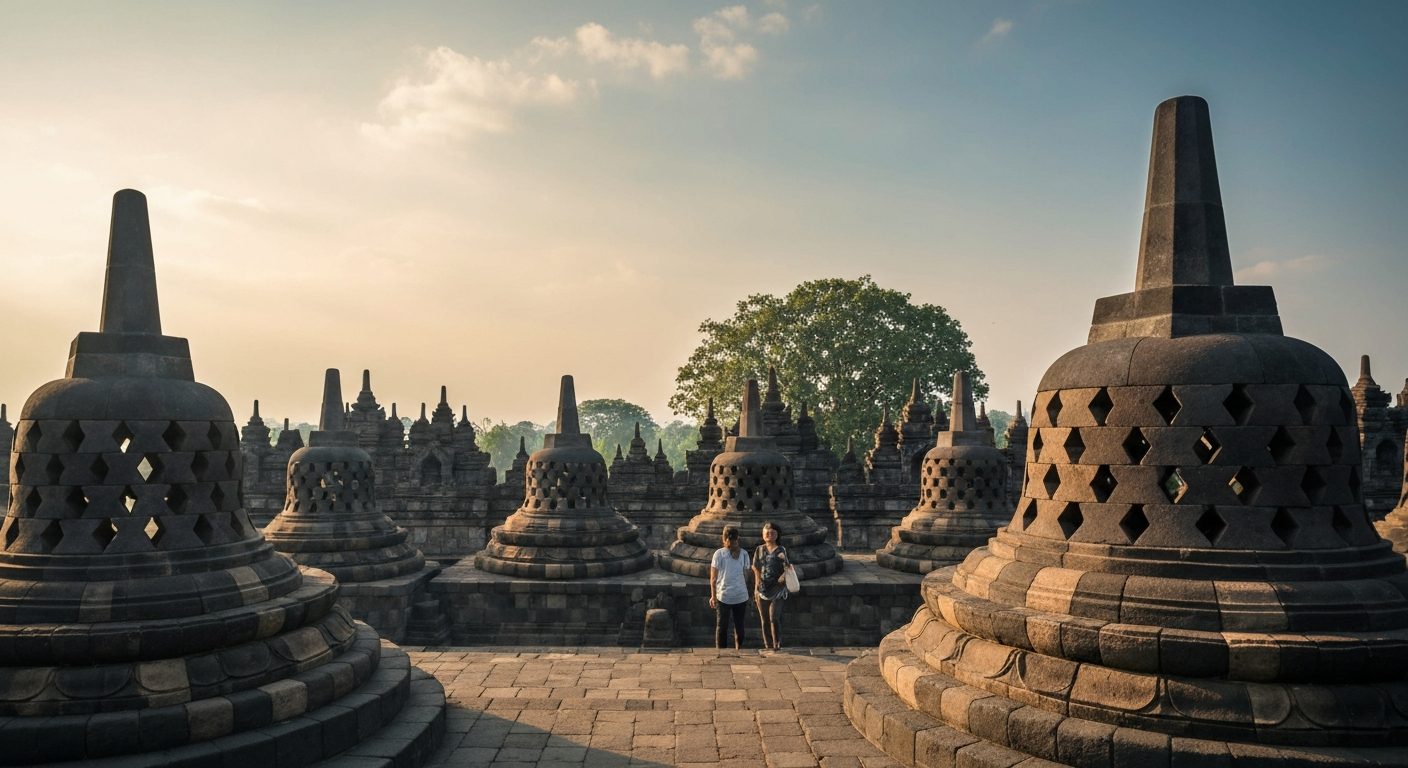
Borobudur temple history is the story of how a 9th‑century Mahayana Buddhist monument in Central Java was built, buried, rediscovered, and finally preserved as a UNESCO World Heritage Site. Today, Borobudur is the largest Buddhist temple in the world and one of the key reasons many of our guests add Central Java to their Bali itinerary.
As Bali-based planners who send travelers to Borobudur week in, week out, we see a pattern. The trips feel far richer when you arrive already understanding who built this place, why it was abandoned, and what the reliefs are actually saying. This page is my attempt to give you that grounding before you stand in front of the stone.
—
What is Borobudur and when was it built?
Borobudur is a 9th‑century Mahayana Buddhist temple complex in Magelang, Central Java, about 40 km northwest of Yogyakarta. It was built during the era of the Sailendra dynasty, most likely between the late 8th and early 9th centuries CE, and completed around the mid‑9th century.
The monument is a giant three‑dimensional mandala:
- A square base and four stepped terraces (the Kamadhatu and Rupadhatu realms)
- Topped by three circular terraces and a central stupa (the Arupadhatu realm)
In total, Borobudur’s walls and balustrades carry 2,672 relief panels and 504 Buddha statues, with 72 of those Buddhas seated inside latticed stupas on the upper circular terraces. For a first‑time visitor, that is a lot of stone. Understanding the story behind it helps the whole site make sense.
—
Timeline of Borobudur: From Sailendra Dynasty to UNESCO
To get a clear sense of Borobudur temple history, it helps to see the main periods side by side.
| Period | Approx. Dates | What happened |
|---|---|---|
| Sailendra construction | Late 8th – mid‑9th century | Mahayana Buddhist Sailendra rulers commission and complete Borobudur as a monumental shrine and pilgrimage site. |
| Use & local prominence | 9th – 14th century | Borobudur functions as a religious and cultural center in the Kedu Plain; later overshadowed by new political centers and Islam’s spread. |
| Decline & burial | ~14th – 18th century | Volcanic ash and jungle growth cover large areas; site falls out of regular use and survives mostly in local stories. |
| Colonial “rediscovery” | 1814 – late 19th century | Under British administration, reports reach Sir Thomas Stamford Raffles; later surveys and partial clearances follow under Dutch rule. |
| First major restoration | 1907 – 1911 | Dutch engineer Theodoor van Erp leads structural consolidation and reconstruction of many stupas and reliefs. |
| UNESCO‑supported restoration | 1973 – 1983 | Indonesia and UNESCO carry out a large‑scale project to dismantle, clean, drain and rebuild key sections. |
| UNESCO inscription | 1991 | Borobudur is listed as a UNESCO World Heritage Site for its outstanding universal value. |
Let’s walk through those periods in a bit more detail.
—
Borobudur in the 8th–9th Century: Sailendra Dynasty & Mahayana Buddhism
The Sailendra dynasty’s role
The Sailendra dynasty dominated Central Java in the 8th and 9th centuries and is closely linked to the borobudur 8th century sailendra dynasty history that you’ll see referenced in academic work and at the site museum.
Key points about the Sailendras:
- They were strong patrons of Mahayana Buddhism, while other Javanese dynasties in the region followed Hinduism.
- Inscriptions from the period suggest deep links with other Buddhist centers in Southeast Asia, including Sriwijaya (in Sumatra) and possibly Nalanda in India through scholarly exchange.
- They left several major Buddhist monuments besides Borobudur, such as Mendut and Pawon, forming a ritual axis in the Kedu Plain.
Most historians date the construction of Borobudur to roughly 780–850 CE, based on style, inscriptions, and comparisons with other temples in the region. There is no single “foundation stone” naming one king and one year; instead, the picture comes from combining several sources.
Why build something this large here?
Borobudur stands on a slightly elevated area in the Kedu Plain, encircled by mountains and volcanoes such as Merapi, Merbabu and Sumbing, with the Progo and Elo rivers nearby. For the Sailendras, this was a spiritually charged landscape.
Borobudur appears to have served:
- As a massive stone mandala, a diagram of the Buddhist cosmos that pilgrims could physically walk.
- As a teaching tool: the reliefs tell stories from the Buddha’s life, previous births and Buddhist texts; walking the galleries is like reading a carved library.
- As a political statement: erecting the most ambitious Buddhist monument in the region showed the Sailendras’ resources and their role as protectors of the Dharma.
The end result is what we now know as the borobudur temple 9th century buddhist masterpiece.
—
Architecture, Cosmology and the Meaning of the Reliefs
To understand Borobudur temple history and meaning explained in a useful way for a visit, you need three core concepts: the three realms of existence, the layout, and the story cycles in the reliefs.
The three realms: Kamadhatu, Rupadhatu, Arupadhatu
Borobudur is built as a representation of the Mahayana Buddhist cosmology:
- Kamadhatu – Realm of desire
- The lowest level, associated with attachment to sense pleasures and karma. At Borobudur, this is the buried base with 160 reliefs, plus the visible lowest terrace.
- Rupadhatu – Realm of form
- Four square terraces with galleries of narrative reliefs and Buddha statues in niches. Here, form still exists but is more refined and closer to awakening.
- Arupadhatu – Formless realm
- The three circular upper terraces with openwork stupas and the large central stupa. Minimal decoration, symbolizing the formless states and ultimate emptiness.
As you walk clockwise from the lower galleries up to the circular terraces, you are reenacting the path from ignorance to enlightenment. This is intentional. The pilgrim’s movement is part of the monument’s function.
Borobudur reliefs: meaning and history
There are 2,672 carved relief panels in total, divided into narrative panels and decorative panels. The borobudur reliefs meaning and history fall into several main cycles:
- Karmawibhangga (Kamadhatu, mostly buried):
Depicts cause and effect — good and bad deeds and their consequences. Scenes include acts of generosity, violence, everyday village life, court scenes, and depictions of hellish states. One exposed section on the southeast side is visible today and often highlighted by local guides.
- Lalitavistara (1st gallery, main wall):
Tells the life of Siddhartha Gautama, from his descent from Tushita heaven, birth at Lumbini, youth in the palace, renunciation, awakening at Bodhgaya, and first teachings.
- Jatakas and Avadanas (1st gallery, balustrade; 2nd gallery):
Stories of the Buddha’s previous lives (Jatakas) and edifying tales of other wise or heroic figures (Avadanas), teaching virtues like generosity, patience and wisdom.
- Gandavyuha & Bhadracari (3rd and 4th galleries):
Follows the pilgrim Sudhana meeting 53 spiritual teachers, including both laypeople and advanced bodhisattvas. It shows that wisdom can appear in many forms and places.
When you walk with a good guide, these stories stop being just “old carvings”. You start to see humour, daily life, court politics, even fashion details from 1,200 years ago.
From a planning perspective: a focused circuit of the key reliefs takes about 1.5–2 hours. A more detailed exploration, stopping to unpack several story cycles, easily runs 3 hours. On our private tours we normally build in 2–2.5 hours inside the temple complex itself, then adjust on the day based on your pace and interest.
—
Decline, Abandonment and Local Memory
Why did Borobudur fall out of use?
By the 14th–15th centuries, several forces likely combined to reduce Borobudur’s importance:
- The political and economic center of Java shifted away from the Kedu Plain towards the coast and later to East Java.
- Islam spread across Java, reorienting religious life and patronage.
- Volcanic activity from nearby mountains, especially Merapi, and earthquakes gradually damaged the structure.
- Erosion and vegetation growth made access harder, especially if state support for maintenance had already faded.
Borobudur was not literally “forgotten overnight”, but over generations it became less central to public ritual life. The upper terraces accumulated ash and soil; plants rooted themselves in joints; some stones collapsed or slid.
Local stories before “rediscovery”
Though formal worship declined, local villagers preserved Borobudur in oral tradition. Folktales spoke of an ancient mountain of stone, sometimes with warnings of misfortune for those who disturbed it.
This pattern — a large ancient site remembered in local stories but not maintained at state level — is common across Java and Bali. When guests ask us on tour why locals “abandoned” such sites, we often explain it more as a shift in focus rather than deliberate rejection.
—
Colonial “Rediscovery” and Early Interventions
Raffles and the first reports
In 1814, during the brief British administration of Java, the Lieutenant‑Governor Sir Thomas Stamford Raffles heard about a large ruined monument in the Kedu area. He asked a Dutch engineer, H.C. Cornelius, to investigate. Cornelius and his team cleared vegetation, documented the structure and sent reports back.
Raffles later described Borobudur in his book The History of Java (1817). That publication brought Borobudur to the attention of European scholars and administrators, though work on the site remained sporadic.
19th‑century clearances and damage
Under Dutch colonial rule, several partial clearances and surveys took place in the later 19th century. Unfortunately:
- Some stones and Buddhas were removed as souvenirs or sent to museums and private collections.
- Lacking modern conservation methods, certain repairs used incompatible materials or poor drainage, which later created new problems.
By the end of the 19th century, concerns about the monument’s stability grew. Parts of the structure were visibly slumping; water seepage threatened the inner core.
—
Van Erp’s 1907–1911 Restoration
Who was Van Erp?
Theodoor van Erp, a Dutch engineer and army officer, led the first significant technical restoration between 1907 and 1911. His work is central to any serious borobudur temple history facts list.
What did the 1907–1911 project do?
Van Erp’s team:
- Dismantled and rebuilt many of the upper stupas, fixing their profiles and stability.
- Cleaned and reassembled hundreds of loose stones and Buddha statues.
- Installed some basic drainage to channel rainwater off the terraces.
- Documented the monument with photographs and drawings.
His restoration was constrained by budget limits and the technical knowledge of the time. He wanted to undertake a more thorough dismantling to fix water seepage in the lower levels but was not authorised to do so. Even so, he preserved large parts of the temple from further collapse.
When you walk the upper circular terraces today and see rows of stupas in relatively clean alignment, much of that visible order traces back to Van Erp.
—
The 1973–1983 UNESCO–Indonesia Campaign
By the mid‑20th century, it was clear that Borobudur needed more than cosmetic fixes. Water infiltration, biological growth and structural stress were serious.
Why a new restoration was needed
Key issues identified by Indonesian experts and later by UNESCO missions included:
- Decayed and clogged drainage, causing standing water on terraces.
- Pressure from the weight of the stone on a partially unstable fill core.
- Biological growth — mosses, lichens — accelerating stone deterioration.
- Increased visitor numbers, especially after independence, adding wear.
In response, the Government of Indonesia and UNESCO launched a joint restoration project in 1973, supported by international funding and expertise.
What the 1973–1983 restoration involved
This was a huge engineering and conservation undertaking:
- Dismantling and reassembling the five lower terraces:
Hundreds of thousands of stones were numbered, removed, cleaned, given better drainage behind them, and then reassembled in their original positions.
- Installing modern drainage systems:
New channels and water barriers were designed to move rainwater away from the core, reducing seepage and stone decay.
- Cleaning and conserving reliefs:
Specialists cleaned biological growth and applied conservation treatments to protect the carvings against weathering.
- Stabilising the structure:
Engineering solutions strengthened the monument’s base and inner core without altering its outward appearance.
The project ran for about 10 years, from 1973 to 1983. If you stand on the lower galleries today and see clean joins, functioning water spouts and relatively crisp carvings for a 1,200‑year‑old monument, that is the direct result of this campaign.
—
Borobudur as a UNESCO World Heritage Temple
1991 inscription and criteria
In 1991, Borobudur was inscribed on the UNESCO World Heritage List as Borobudur Temple Compounds. This borobudur unesco world heritage temple inscription covers not just Borobudur itself but also nearby Mendut and Pawon, reflecting their ritual links.
Borobudur was listed under cultural criteria including:
- Representing a masterpiece of human creative genius.
- Bearing exceptional testimony to a cultural tradition and a major stage in human history.
- Being an outstanding example of a type of building and landscape illustrating a significant stage in history.
This is the formal way of saying that Borobudur is not only important for Indonesian Buddhists or Javanese history, but of “outstanding universal value” for all humanity. That phrase is the core of borobudur unesco world heritage site significance.
What UNESCO listing changes in practice
World Heritage status:
- Helps secure and justify funding for ongoing conservation.
- Encourages stricter protection regulations around the site.
- Attracts global attention — which brings benefits (visitors, research) and pressures (crowding, infrastructure stress).
On the ground, Borobudur is managed by Indonesian authorities, with UNESCO playing a recommending and monitoring role rather than day‑to‑day control.
—
Visiting Borobudur Today: Access, Time and Crowd Management
As a planning desk based in Bali, our job is to help you experience this history in a way that feels calm and informed, not rushed and confusing.
Practical visiting facts
Some essentials we factor into itineraries (last verified June 2026; operational details can change):
- Location: Near Borobudur village, Magelang Regency, Central Java; about 1.5–2 hours by road from Yogyakarta, depending on traffic.
- Opening hours: Typically early morning to late afternoon; special arrangements apply for dawn access or upper‑level quotas.
- Visit duration:
- Quick overview: ~1.5 hours in the complex
- Solid historical visit: 2–3 hours
- Deep dive with photography: 3+ hours
- Access to upper terraces:
In recent years, Indonesia has occasionally limited access to the very top levels (Arupadhatu) to protect the stones, often using timed quotas or mandatory guide escorts. These rules evolve; we check the latest conditions before your travel dates.
Borobudur from Bali: Time and budget
A realistic private Borobudur visit from Bali typically involves:
- Flights Bali (DPS) – Yogyakarta (YIA/JOG) – Bali: usually 1–1.5 hours each way in the air, plus airport transfers.
- At least 1 very long day (pre‑dawn start, late night return) or, more comfortably, 1–2 nights in Yogyakarta or near Borobudur.
Indicative budget ranges for a Bali–Borobudur add‑on (last verified June 2026, very dependent on season, airline, hotel choice, and group size):
- Private sunrise‑focused 1‑night trip ex‑Bali with flights, private car/driver in Java, local licensed guide, and mid‑range lodging:
around US$350–700 per person for 2–4 travelers.
- More relaxed 2‑night Yogyakarta + Borobudur + Prambanan program on a private basis:
commonly US$550–1,100 per person for 2–4 travelers.
These are broad indicative ranges, not fixed quotes. Our own Bali Premium Trip reservations team prices trips at transparent, published rates at the time you book, with no third‑party mark‑up. On the ground in Central Java we arrange licensed local guides, vehicles and any park‑run services (like official temple guides or sunrise access) through vetted partners.
If you want help mapping a realistic Borobudur side‑trip into your Bali holiday, you can always plan your trip with us directly or chat with our team via WhatsApp for quick timing checks and options.
—
Why this history matters for your visit
Understanding Borobudur temple history does more than help you answer quiz questions. It shapes what you choose to do on site.
Some examples:
- Knowing that the Karmawibhangga panels on the buried base are mostly hidden explains why most tours focus on the first and second galleries — and why the small exposed section is so important.
- Understanding the Lalitavistara sequence changes how you see the reliefs: you stop treating each panel as isolated and start recognising stages in the Buddha’s life.
- Grasping the Gandavyuha story helps you relate to the idea that your own pilgrimage, even as a modern visitor flying from Bali, fits into a long tradition of seekers moving from teacher to teacher.
- Recognising that much of what you see is the product of 20th‑century restoration adds respect for conservation work. The temple is not just a remnant of the 9th century; it’s also a 1907–1911 and 1973–1983 project.
When we build itineraries, we usually recommend:
- A predawn start if you want to see the wider landscape shift from darkness to light, often from a nearby hill viewpoint like Punthuk Setumbu, then head into Borobudur as the reliefs become readable in the morning light.
- Or a later morning slot if you prefer to trade sunrise for a bit more sleep and slightly thinner crowds at certain times of year.
Both patterns work — the best choice depends on your energy levels, time in Java and what you want to emphasise (landscape vs stone detail). Our role is to arrange the transfer logic, temple timings and licensed guides so you spend more time absorbing the site and less time worrying about queues and road routes.
For route ideas and sample schedules, our Borobudur sunrise and day‑tour pages break the options down by starting point (Bali vs Yogyakarta) and style (private vs small group). When you’re ready to tailor that to your dates, just plan your trip with our Bali Premium Trip team via email or WhatsApp — we answer from Bali, and coordinate the Central Java pieces with our on‑ground partners.
—
FAQs on Borobudur Temple History
Who built Borobudur and in which century?
Borobudur was built by the Mahayana Buddhist Sailendra dynasty in Central Java, most likely between the late 8th and mid‑9th centuries CE. This period overlaps with other Sailendra‑era Buddhist temples like Mendut and Pawon.
Why is Borobudur considered the largest Buddhist temple in the world?
Borobudur is often described as the largest Buddhist temple in the world because of its overall footprint, volume and the scale of its stone construction: nine stacked platforms (six square and three circular), a central stupa, 504 Buddha statues and 2,672 relief panels. While some modern complexes may cover wider areas, no other single ancient Buddhist monument matches Borobudur’s combination of size and sculptural detail.
What makes Borobudur a UNESCO World Heritage Site?
Borobudur was inscribed as a UNESCO World Heritage Site in 1991 for its outstanding universal value as a masterpiece of Buddhist art and architecture, its detailed narrative reliefs that document 9th‑century Java, and its role as an exceptional example of a Buddhist mandala expressed in three‑dimensional form. The listing helps protect the site and supports ongoing conservation efforts.
What do the reliefs at Borobudur depict?
The reliefs at Borobudur show scenes from the Buddha’s life (Lalitavistara), his previous lives (Jatakas), inspiring stories about other figures (Avadanas), teachings on karma and its results (Karmawibhangga), and the pilgrim Sudhana’s encounters with many teachers (Gandavyuha and Bhadracari). Together, they function as a visual teaching manual for Mahayana Buddhism.
Can I see everything at Borobudur in a single visit?
You can visit the main terraces and get a coherent sense of Borobudur’s history and symbolism in one well‑planned visit of about 2–3 hours, especially with a knowledgeable licensed guide. However, fully appreciating all 2,672 relief panels and their stories would take much longer, so most visitors focus on selected galleries and key viewpoints rather than trying to see every panel in detail.