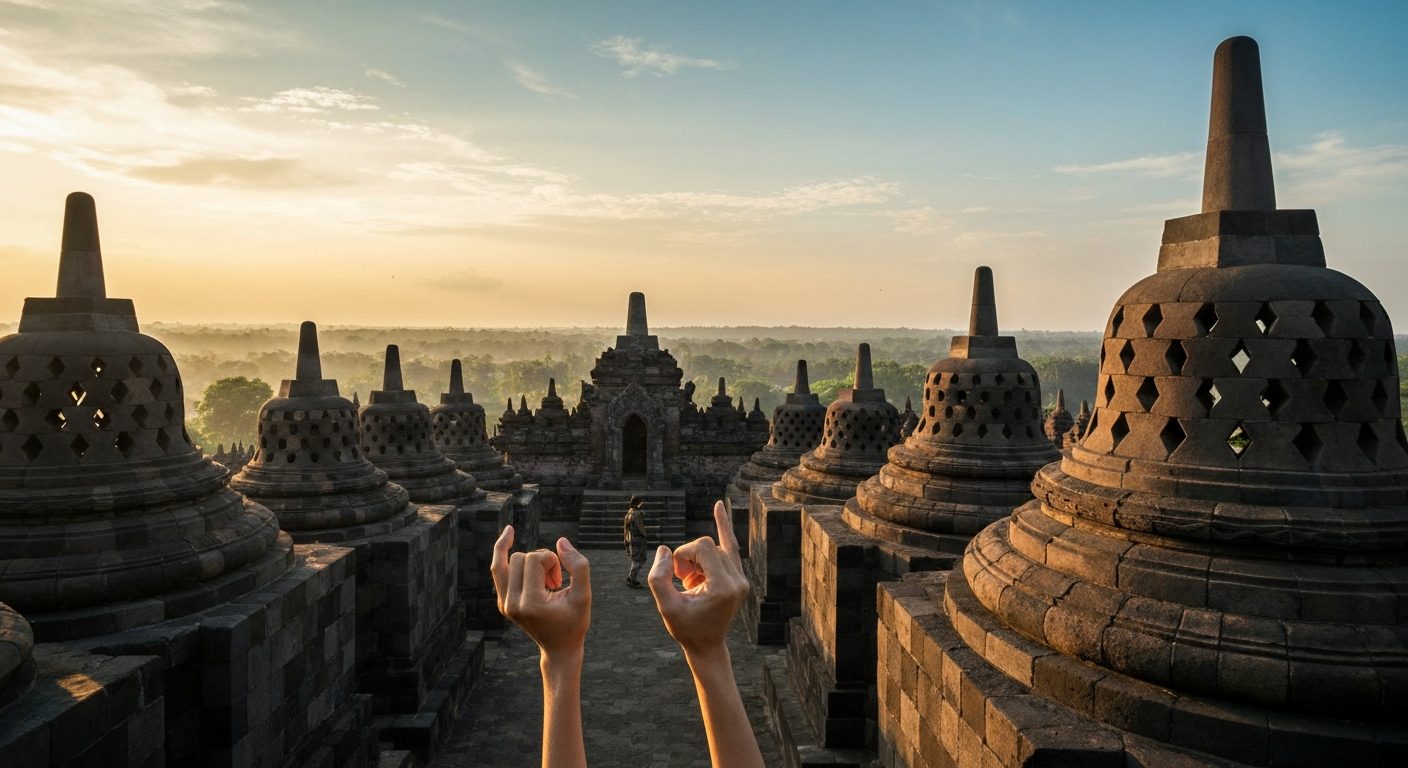
Borobudur vs Prambanan which to visit is the question most Central Java first-timers ask. The short answer: if you have just one full day near Yogyakarta, aim to see both, and prioritise Borobudur for sunrise and Prambanan for late afternoon to sunset.
As Bali-based planners sending guests to Central Java several times a week, we see the same decision pattern. Some travellers have only one morning from Yogyakarta. Others are doing a fairly tight “Borobudur and Prambanan tour from Bali” with an early flight in and evening flight back. This guide lays out the trade‑offs clearly, so you can decide calmly where to spend your limited time and energy.
I’m Wira Anandika, Tour Editor for Borobudur Tour From Bali at Bali Premium Trip. My team in Bali arranges your flights or train connections, private drivers, licensed local guides and temple permits; our on‑ground partners in Yogyakarta and Magelang operate the actual guiding and transport there. You book directly with our Bali office at transparent, published rates, and we coordinate the rest.
—
Borobudur vs Prambanan: quick comparison
To start, here is a side‑by‑side “borobudur vs prambanan temple comparison” of the key facts most travellers care about.
| Aspect | Borobudur | Prambanan |
|---|---|---|
| Religion & style | Buddhist; giant stone mandala with bell‑shaped stupas | Hindu; tall pointed spires (shikharas) and shrines |
| Main period | 8th–9th century (Sailendra dynasty) | 9th century (Mataram Hindu kingdom) |
| UNESCO status | Part of “Borobudur Temple Compounds” site | Part of “Prambanan Temple Compounds” site |
| Nearby city | Magelang Regency, ~40 km NW of Yogyakarta | On the Yogyakarta–Solo axis, ~17 km E of Yogyakarta |
| Drive from Yogyakarta city | ~1.5 hours in normal traffic | ~45–60 minutes in normal traffic |
| Typical time inside | 2–3 hours including photo and quiet time | 1.5–2.5 hours including main complex and side temples |
| Best light | Very early morning; sunrise from nearby hills, soft light for the temple | Late afternoon to sunset; golden sidelight on the spires |
| Climb access | Limited, by timed quota with mandatory guide | More open; you can walk through courtyards and some inner zones (subject to safety rules) |
| Overall feel | More contemplative; broad open terraces and stupas | More vertical and dramatic; sharp silhouettes and reliefs |
| Nearby satellites | Mendut & Pawon Buddhist temples in a straight line | Sewu, Lumbung, Bubrah within the same archaeological park |
—
How Borobudur and Prambanan actually differ on the ground
Many online articles summarise the temples as “Buddhist vs Hindu” and stop there. That’s accurate, but not very helpful for planning a day.
Here’s how the experience really differs.
Architecture and atmosphere: stupas vs spires
Borobudur
Borobudur is a massive stone pyramid built as a three‑dimensional mandala. You move from wide square terraces with narrative reliefs up to circular terraces with 72 perforated stupas and a central stupa at the top.
The feeling is:
- Broad, open spaces rather than tight corridors.
- Repetition of stupas that encourages slow walking and reflection.
- Long, story‑rich relief panels about the Buddha’s life and Jataka tales.
Prambanan
Prambanan is a classic Hindu temple complex, with tall central spires dedicated to Shiva, Vishnu and Brahma, surrounded by dozens of smaller shrines.
Expect:
- Strong vertical lines; your eye is drawn upward.
- Relatively compact courtyards, especially in the inner zone.
- Detailed reliefs of the Ramayana and other Hindu epics, plus guardian statues.
If you love wide panoramas and geometry, Borobudur tends to resonate more. If you prefer intricate stonework and towering silhouettes, Prambanan feels more striking.
Religious context and stories
- Borobudur: Purely Buddhist. Many visitors pair it with nearby Mendut and Pawon, forming the traditional “Borobudur Mendut Pawon temple itinerary” that monks still walk for special ceremonies.
- Prambanan: Hindu, with clear parallels to temples in India and Cambodia. The Ramayana Ballet (performed in Yogyakarta and near the temple on select nights) uses Prambanan’s spires as a backdrop during the dry season.
You do not need prior knowledge of either religion to appreciate the sites. A good local guide, which we arrange as standard, can explain the main carvings on a 60–90 minute walk.
—
Location and distance: Magelang vs Yogyakarta plains
Understanding the geography helps answer the core question: Borobudur vs Prambanan which to visit in a limited window.
Where Borobudur sits
Borobudur lies in Magelang Regency, northwest of Yogyakarta city. The temple sits in a fertile basin framed by volcanoes like Merapi and Merbabu.
- Drive time from central Yogyakarta: around 1.5 hours each way in typical traffic.
- Drive time from Yogyakarta International Airport (YIA): usually 1.5–2.5 hours one way, depending on time of day and toll road use.
Nearby, you find the small villages of Borobudur district, Punthuk Setumbu and other hill viewpoints, plus the smaller Mendut and Pawon temples.
Where Prambanan sits
Prambanan is on the eastern side of Yogyakarta, closer to Solo (Surakarta).
- Drive time from central Yogyakarta: about 45–60 minutes.
- Drive time from YIA: usually 1.5–2 hours, often via Yogyakarta city bypass.
Prambanan sits in a broad, open plain, which gives it a very different visual context from Borobudur’s more enclosed basin.
Distance between Borobudur and Prambanan
- Borobudur to Prambanan: allow 1.5–2 hours of driving time, typically routing via Yogyakarta’s ring roads.
This is why a “Borobudur Prambanan Magelang Yogyakarta tour” in one day is very doable, as long as your timing is realistic and you use a private driver who knows the roads.
—
Time needed at each temple
You don’t have to rush either site, but you also don’t need a full day at just one unless you want long, quiet contemplation.
Borobudur: 2–3 hours is enough for most
A typical Borobudur visit looks like this:
- 15–20 minutes: walk from entrance, shuttle, reach the base.
- 60–90 minutes: guided loop covering key reliefs and climbing to the upper terraces (subject to current access rules).
- 30–45 minutes: personal photo time, sitting quietly near the stupas, or exploring the onsite museum.
If you add Mendut and Pawon, the Borobudur Mendut Pawon temple itinerary adds:
- ~15 minutes drive to Mendut.
- 20–30 minutes to look around.
- ~10 minutes drive to Pawon.
- Another 15–20 minutes there.
Prambanan: 1.5–2.5 hours
Inside Prambanan’s main complex:
- 60–90 minutes for a guided walk around the major temples and reliefs.
- Optional extra 30–45 minutes to visit nearby Sewu temple (highly recommended if you enjoy photography) using the park shuttle or walking path.
Combined, most guests spend 2–3 hours within the Prambanan archaeological park if they explore beyond the main courtyard.
—
Sunrise vs sunset: which temple at which time?
This is one of the most common planning questions, and it has a practical answer.
Borobudur: best paired with early morning
Real sunrise inside Borobudur’s upper terraces has, as of 2024–2025 policies, been heavily restricted compared to pre‑pandemic years. Access rules can change, but generally:
- The earliest regular public entry is after actual sunrise.
- Special early entry programs (when available) are limited and sell out quickly.
However, the Borobudur sunrise experience is still very strong, because:
- You can watch sunrise from nearby hills like Punthuk Setumbu or certain village viewpoints, then head into the temple as the soft morning light continues.
- Morning temperatures are gentler and haze is usually kinder for views of Merapi and the surrounding valley.
We time our Borobudur sunrise routes so guests wake up absurdly early once, watch first light from a viewpoint, then reach the temple as it opens to the general public or to their timed slot.
Prambanan: shines in late afternoon and sunset
Prambanan’s spires catch the low afternoon sun very well. The light stretches shadows across the courtyard, and the temperature starts to ease.
For most itineraries, we suggest:
- Visit Prambanan from about 15:30–17:30 or up to sunset when possible.
- If your schedule allows, stay a bit longer to see the complex under early evening light.
So our honest recommendation:
- If you only have a half day in the morning: choose Borobudur.
- If you only have a half day in the afternoon: choose Prambanan.
- If you have a full day: plan Borobudur first (with or without a nearby sunrise viewpoint), Prambanan later.
—
Tickets, climb access and reality on the ground
One area where expectations often clash with reality is banner photos versus current regulations.
Borobudur tickets and climb quotas
As a protected UNESCO World Heritage site, Borobudur now manages visitor numbers more tightly:
- There are separate categories for temple yard access and stupa‑level / upper terrace access.
- Upper‑level climbs typically use a timed, limited quota system with mandatory guide, special footwear and a maximum stay period per slot.
- Policies and prices have changed several times in recent years and may shift again, so we always confirm the latest rules when planning your date.
What this means for you:
- You should not assume you can sit alone beside a stupa at sunrise like in older photos.
- You should factor some flexibility into your timing and accept that conservation rules come first.
We arrange Borobudur ticketing and climb slots as part of our private itineraries so that your driver, local guide and entrance times match.
Prambanan tickets and access
Prambanan is more straightforward:
- A single regular ticket (with higher rates for foreigners than for Indonesian nationals) covers entry to the main complex and usually the wider park, including Sewu, subject to internal shuttle arrangements.
- Some inner chambers and staircases remain closed for structural safety and conservation; your guide will explain what is accessible.
Unlike Borobudur, there is currently no strict timed‑quota system for basic access, but crowd levels can grow during local school holidays and weekends.
—
Crowd levels and seasons
Both temples are popular. But crowd patterns differ.
Borobudur crowds
- Early morning is usually quieter than late morning, even accounting for sunrise‑view seekers.
- Indonesian public holidays and long weekends can bring large domestic tour groups, especially mid‑morning.
- Upper terraces feel more controlled due to the quota system; the base levels may feel busier.
Prambanan crowds
- Late afternoon is popular, but space is fairly generous, and photos without dense crowds are still very possible with smart angles.
- Midday sun can feel harsh; many day‑trippers rush through, which sometimes leaves late afternoon pleasantly manageable outside peak holiday weeks.
As a planning desk, we don’t pretend we can “avoid all crowds”. That is not realistic. What we can do is time your entries, routes and photo stops to reduce the feeling of being swept along by group tours.
—
Borobudur vs Prambanan – if you must choose one
Some visitors simply cannot fit both monuments into their plan. In that case, how to decide?
Reasons some travellers decide Borobudur is better than Prambanan (for them)
The phrase “why borobudur better than prambanan” shows up a lot in search, but the truth is more nuanced. Borobudur is not inherently “better”, but it may be a better match for certain travellers:
- You are more interested in Buddhist heritage.
- You place high value on wide viewpoints, volcano backdrops and the visual of stupas against the sky.
- You enjoy long, narrative stone reliefs that you can follow as a story walk.
- You are comfortable with very early starts for sunrise viewpoints and don’t mind extra driving.
Reasons some travellers prefer Prambanan
Prambanan might be the smarter choice if:
- You want to minimise drive time from Yogyakarta city or YIA and keep things lighter.
- You are fascinated by Hindu epics and want to connect them with temples you might have seen in India, Cambodia or Bali.
- You like sharp silhouettes and geometric vertical lines in your photos.
- You prefer not to navigate changing climb‑quota rules and timed slots.
If pressed to give a one‑line answer:
-For a more contemplative, “world‑icon” feel, pick Borobudur.
-For a more dramatic profile and easier logistics, pick Prambanan.
But if you can stretch your day, the better answer is still: do both.
—
Borobudur and Prambanan same day: is it possible?
“Borobudur Prambanan same day possible” is another question we hear constantly in WhatsApp chats. The realistic answer: yes, for most travellers, if you are willing to have a full, structured day and start early.
Typical same‑day outline from Yogyakarta
Here’s a common pattern our guests follow:
- 03:00–04:00: Depart Yogyakarta hotel with private driver.
- 04:30–05:30: Sunrise from a hill viewpoint near Borobudur (e.g. Punthuk Setumbu or similar; exact location depends on current access and weather).
- 06:00–09:00: Borobudur visit with licensed local guide, including time inside and optional onsite museum.
- 09:15–10:30: Mendut and Pawon visit by car, short walks.
- 10:30–12:00: Drive toward Yogyakarta / Prambanan, lunch stop.
- 13:00–15:00: Rest at hotel or café in Yogyakarta (if overnighting) or continue straight to Prambanan for an earlier visit.
- 15:30–18:00: Visit Prambanan complex and, time allowing, Sewu temple. Watch light change toward sunset.
- 18:00–19:00: Return to Yogyakarta hotel.
This is a full day. You will be tired but satisfied. Many guests tell us this single day gives them a solid sense of Central Java’s culture before heading back to Bali or onward to other islands.
Same‑day outline from Bali (fly in, fly out)
A “Borobudur and Prambanan tour from Bali” in one day is also possible, but only for travellers who accept an intense schedule:
- Early morning flight from Bali to YIA (or sometimes Solo, depending on flight times).
- Full‑day private Borobudur Prambanan combination tour with our Yogyakarta‑based team.
- Evening flight back to Bali.
This kind of day typically runs 15–18 hours door‑to‑door from your Bali hotel. It makes sense for visitors who cannot spare an overnight in Yogyakarta but deeply want to see both temples.
Indicative, not‑binding cost (last verified June 2026):
-for a private same‑day Bali–Central Java–Bali arrangement, including flights, private car and driver in Java, licensed guide and temple entrance tickets, our guests usually see packages in the range of US$350–550 per person based on 2–4 travellers and time of year. Larger groups often lower the per‑person figure. Exact quotes vary by airline, season and specific program.
If you’d like us to sketch what this could look like for your dates, you can plan your trip with our Bali Premium Trip reservations team or message us directly on WhatsApp at +62 811 2859 0000.
—
Why we usually recommend: do both, in one structured day
From years of arranging these trips, here’s the pattern we see:
- Guests who choose just one temple often say later, “Next time I’ll add the other.”
- Guests who do both in one day almost never say it felt unnecessary; they remember them as complementary, not redundant.
How the two complement each other
- Chronology: Both emerge from the same broad period of Central Javanese history but show different religious and artistic directions.
- Visual variety: Your photos and memories will not blur together. One is all stupas and terraces; the other is spires and courtyards.
- Narrative: You move from Buddhist cosmology in the morning to Hindu epics in the afternoon. The mental shift keeps the day engaging.
Adding Mendut and Pawon: finishing the picture
The small Mendut Pawon temple near Borobudur pair is more than a side note. Historically, monks processed from Mendut to Pawon and on to Borobudur for ceremonies, aligning the three on a straight axis.
Including them in a Borobudur Mendut Pawon temple itinerary adds:
- A more intimate feel: these are small enough to observe details closely without any rush.
- Additional reliefs and Buddha statues that help you understand how Borobudur fit into a living Buddhist landscape, not just as an isolated monument.
Because they are so close, it is inefficient to return on a separate day just for Mendut and Pawon. That’s why we usually slot them into the same morning as Borobudur.
—
Practical tips for planning with Bali Premium Trip
A brief word on logistics and how we work, to keep things transparent.
What we arrange
From our Bali office, we:
- Advise you on Borobudur vs Prambanan which to visit based on your exact flight times, fitness, and interests.
- Book domestic flights or train seats where needed (or coordinate with tickets you purchase yourself).
- Reserve a private car and driver in Central Java sized correctly for your group (from small sedans for 1–2 guests up to minibuses for 10–15+).
- Arrange licensed local guides at Borobudur and Prambanan who are authorised to operate inside the parks.
- Handle temple tickets, climb quotas (subject to availability) and, for sunrise, coordinate your viewpoint access and local hill transport such as small village jeeps where required.
We do not own the national park concessions or the temples. We work within official rules and with accredited on‑ground partners.
Group vs private options
- Private tours (our default):
- You control the pace within reason.
- Door‑to‑door pick‑up from your Bali hotel (for fly‑in/fly‑out days) and from your Yogyakarta accommodation if staying over.
- Easier to adapt to real‑world variables like traffic, weather and your energy level.
- Group tours:
- Shared minibus and a shared guide at the temples.
- Less flexible on timing but more economical for solo travellers or pairs.
- Still arranged through our Bali Premium Trip team so you have a single point of contact.
Typical private Borobudur + Prambanan day arrangements from Yogyakarta (without flights) range from around US$90–180 per person (last verified June 2026), depending on group size, language of guide, and inclusions. Again, these are indicative ranges, not fixed quotes.
To discuss what fits your budget and time frame, you can plan your trip or WhatsApp us on +62 811 2859 0000 for direct, plain‑spoken advice.
—
So: Borobudur vs Prambanan – which should you visit?
Putting it all together:
- If your schedule is very tight and only allows a single morning: choose Borobudur, ideally with a nearby sunrise viewpoint.
- If you only have a single afternoon: choose Prambanan, aiming for late light and, if possible, also Sewu within the park.
- If you have a full day in Central Java:
- Do both.
- Morning: Borobudur + Mendut + Pawon.
- Afternoon: Prambanan and, time allowing, Sewu.
- This is the classic Borobudur Prambanan combination tour that gives you a rounded view of Central Javanese history and culture.
From Bali, we help you slot that day into a wider Indonesian route without wasting hours on awkward connections. From Yogyakarta, we help you make the most of the single day you might have.
If you’d like a clear, no‑pressure outline for your dates and group size, our Bali Premium Trip team is reachable via plan your trip, WhatsApp at +62 811 2859 0000, or email at sales@balipremiumtrip.com.
—
FAQs: Borobudur vs Prambanan
Can I visit Borobudur and Prambanan in one day from Bali?
Yes, it is possible but it will be a very full day. You need an early morning flight from Bali to Central Java, a tightly planned private Borobudur Prambanan combination tour, and an evening return flight. Expect 15–18 hours door‑to‑door; we arrange all transfers, guides and tickets to keep it manageable.
Is Borobudur still open for sunrise on the temple itself?
Policies have changed in recent years. As of the latest updates, general sunrise access on the top terraces is restricted and controlled by timed quotas and special programs when available. Most visitors now watch sunrise from nearby hills such as Punthuk Setumbu, then enter Borobudur soon after opening. We always check the current rules for your exact date.
How much walking and climbing is involved at each temple?
Borobudur involves walking up and down multiple stone terraces via staircases; even with limited climb access, you should expect several sets of steps and uneven surfaces. Prambanan is flatter overall inside the main courtyard but still has stairs to reach some elevated platforms. Good footwear and reasonable mobility are important for both sites.
Is a guide necessary at Borobudur and Prambanan?
Officially, some Borobudur climb programs require a guide, and at both temples a licensed local guide adds a lot of value by explaining the reliefs and history. We strongly recommend guided visits, and our tours include licensed guides as standard rather than treating them as an afterthought.
Which temple is better for families with children?
Both can work well for families. Borobudur offers more open space for kids to move around but involves more climbing. Prambanan has dramatic shapes and slightly easier walking, which many children enjoy. For younger kids or very early‑rise‑averse families, Prambanan in the late afternoon is often the easier first choice; with older children, a structured Borobudur + Prambanan day is realistic.