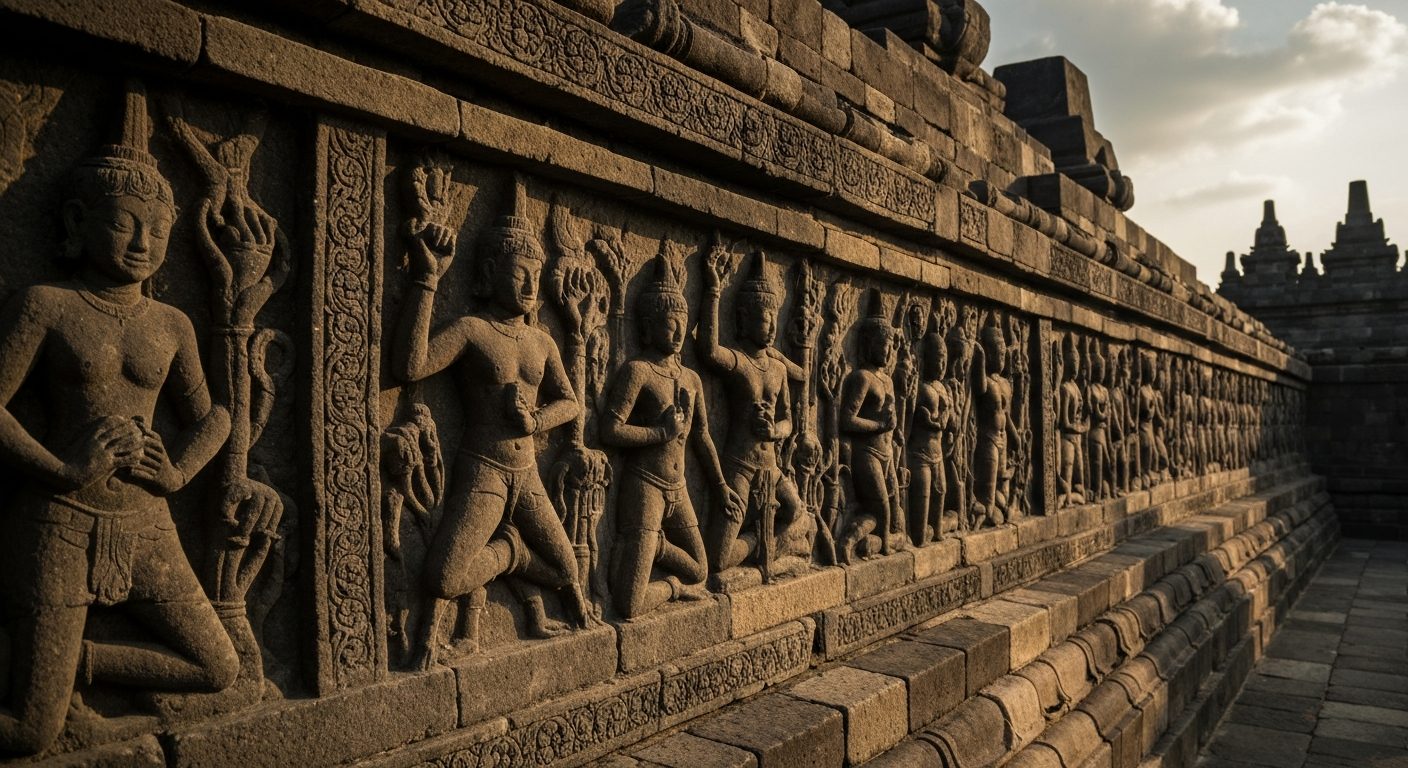
Borobudur’s intricate relief carvings tell a visual history of Buddhist teachings, transforming the monumental temple into a three-dimensional sacred text. Understanding the borobudur relief carvings history is key to unlocking the full meaning of your visit, revealing stories etched in stone from the 8th and 9th centuries.
This guide will walk you through Borobudur’s symbolism, from its tiered platforms representing Buddhist cosmology to the hundreds of Buddha statues and stupas that crown its summit. Our aim is to help you “read” the temple like a book, making your journey up its levels a profoundly meaningful experience.
Borobudur’s Architecture: A Journey Through Buddhist Cosmology
Borobudur is more than a temple; it’s a giant mandala, a diagram of the universe in stone, designed to guide pilgrims from the earthly realm towards enlightenment. The monument is structured into nine stacked platforms: six square ones at the base, followed by three circular ones, culminating in a central stupa. This architectural progression symbolizes the three realms of Buddhist cosmology, known as the Triloka:
- Kamadhatu (The Realm of Desire)
- The lowest and largest level, representing the mundane world where beings are bound by desires and passions. This realm is hidden from view by the temple’s base, reflecting its concealed nature.
- Rupadhatu (The Realm of Forms)
- The middle five square terraces, where desires have been overcome, but beings still possess form and individuality. Pilgrims here encounter the extensive narrative relief panels.
- Arupadhatu (The Realm of Formlessness)
- The upper three circular platforms, representing the highest spiritual state where beings are free from form and earthly attachments, approaching pure consciousness. Here, the statues are enclosed within perforated stupas, signifying immateriality.
As you ascend Borobudur, you are not just climbing steps; you are undertaking a spiritual pilgrimage, moving from the physical world of desire towards the formless serenity of nirvana.
Deciphering Borobudur’s Relief Panels: A Visual Scripture
The borobudur relief panels buddha stories are the heart of the temple’s narrative power. There are approximately 2,672 individual relief panels, stretching for a total length of about 3 kilometers if laid end-to-end. These carvings are not mere decoration; they serve as a comprehensive borobudur relief carvings history guide, illustrating Buddhist doctrines and parables for the illiterate masses of ancient Java.
These panels are primarily found on the Kamadhatu and Rupadhatu levels, wrapping around the temple’s galleries. To properly read them, a pilgrim would circumambulate each gallery clockwise, absorbing the stories as they progressed upwards.
The Kamadhatu: Karmavibhangga Reliefs
The first set of narratives you encounter, though now mostly hidden, is on the temple’s base, known as the Kamadhatu. These are the Karmavibhangga reliefs. They depict the law of karma, illustrating the consequences of good and bad deeds in the realm of desire. For example, scenes show individuals suffering the results of theft, murder, or gossip, juxtaposed with those enjoying the fruits of generosity, kindness, and devotion.
While most of these panels were covered by a retaining wall added for structural stability sometime in the 9th or 10th century, a small section on the southeast corner has been uncovered, offering a glimpse into this fundamental teaching. It reminds us that our actions have repercussions, a core tenet of Buddhist philosophy.
The Rupadhatu: Narratives of Enlightenment
As you ascend to the Rupadhatu, the narratives become increasingly complex and spiritually advanced. These galleries host the bulk of Borobudur’s narrative art, with approximately 1,300 panels.
1. Lalitavitara: The Life of Buddha
On the first gallery, the upper main wall’s reliefs recount the Lalitavitara, the story of Siddhartha Gautama’s final life as the Buddha. This cycle begins with the Buddha’s descent from Tushita heaven as an elephant entering Queen Maya’s womb and concludes with his first sermon at the Deer Park in Sarnath.
These panels depict key moments: his birth in Lumbini, his early life as a prince, his renunciation of worldly life, his ascetic practices, his enlightenment under the Bodhi tree, and his initial teachings. It’s a powerful visual biography, emphasizing the path to awakening.
2. Jataka and Avadana Tales: Past Lives and Noble Deeds
Below the Lalitavitara, on the balustrade of the first gallery and continuing into the second and third galleries, are the borobudur jataka tales relief stories meaning. These are stories of the Buddha’s past lives (Jataka tales) and noble deeds of other bodhisattvas (Avadana tales).
- Jataka tales typically feature the Bodhisattva (the Buddha-to-be) in various forms, often as animals, demonstrating virtues like compassion, generosity, and wisdom. For instance, you might see the Bodhisattva sacrificing himself to feed hungry animals or performing acts of great kindness.
- Avadana tales are similar but focus on the meritorious deeds of other enlightened beings.
These borobudur relief panels buddha stories illustrate the long and arduous path to enlightenment, showing how countless acts of virtue accumulate over lifetimes to achieve Buddhahood. They are parables, teaching moral lessons and reinforcing Buddhist ethics.
3. Gandavyuha and Bhadracari: Sudhana’s Pilgrimage
The most extensive and complex narrative cycle, found on the third and fourth galleries and their balustrades, is the Gandavyuha. This series chronicles the pilgrimage of Sudhana, a young seeker, in his quest for ultimate wisdom. The borobudur bhadracari sudhana wandering stories depict Sudhana visiting a multitude of spiritual teachers (53 in total) from various backgrounds – monks, nuns, gods, goddesses, merchants, and even children – each imparting a piece of wisdom.
The Gandavyuha culminates with the Bhadracari, a final chapter where Sudhana meets Samantabhadra Bodhisattva and makes a vow to follow the ten great vows of a Bodhisattva, dedicating himself to the welfare of all beings. This narrative highlights the importance of seeking wisdom from diverse sources and the Bodhisattva ideal of boundless compassion. It’s a journey of continuous learning and spiritual growth.
The 504 Buddha Statues and Their Mudras
As you progress upwards through the Rupadhatu and into the Arupadhatu, the focus shifts from narrative reliefs to individual Buddha statues. Borobudur is home to borobudur 504 buddha statues stupa, each positioned with deliberate intent.
On the square terraces of the Rupadhatu, the Buddha statues are housed in niches along the balustrades, facing outwards. There are 104 statues on the first square terrace, 104 on the second, 88 on the third, 72 on the fourth, and 64 on the fifth, totaling 432 statues on these levels.
What makes these statues particularly insightful is their hand gestures, known as mudras. Each borobudur buddha statue mudras meaning conveys a specific teaching or moment in the Buddha’s life. The mudras on the Rupadhatu levels are not random; they follow a specific pattern based on the cardinal directions:
| Direction | Mudra (Hand Gesture) | Meaning |
|---|---|---|
| East | Bhumisparsa Mudra | Touching the Earth (Calling Earth to Witness) |
| South | Varada Mudra | Granting Charity or Boons |
| West | Dhyana Mudra | Meditation or Concentration |
| North | Abhaya Mudra | Fearlessness or Protection |
| Zenith | Dharmachakra Mudra | Turning the Wheel of Dharma (Teaching) |
The 72 statues on the top circular platforms (Arupadhatu) all display the Dharmachakra Mudra, symbolizing the Buddha’s first sermon and the turning of the Wheel of Dharma. This consistency signifies the universal nature of the ultimate teaching, transcending directional distinctions.
The Stupas: Symbols of Enlightenment and the Void
Beyond the square terraces, the borobudur buddhist temple nine platforms levels culminate in the three circular platforms of the Arupadhatu. This realm, representing formlessness, is marked by a dramatic shift in architecture. The narrative reliefs disappear, replaced by a minimalist design intended to evoke emptiness and pure consciousness.
Here, 72 smaller, perforated stupas are arranged in concentric circles. Each of these bell-shaped stupas encloses a seated Buddha statue, visible through the diamond, square, or triangular perforations. These borobudur 72 perforated stupas plus the central great stupa symbolize the highest state of spiritual attainment, where individuality begins to dissolve. The perforated design suggests that while a form exists, it is transparent, ephemeral, and on the verge of disappearing into the formless.
At the very apex of Borobudur sits the grand central stupa. This largest stupa is solid, completely enclosing whatever lies within (traditionally believed to be nothing, symbolizing the void of nirvana). It marks the ultimate goal of the Buddhist path: complete enlightenment, a state beyond form, beyond concepts, beyond even the teachings themselves. It is the destination of the spiritual journey Borobudur itself represents.
The journey through the borobudur three realms kamadhatu rupadhatu arupadhatu is a powerful metaphor for the pilgrim’s progress. From the world of desire, through the understanding of forms and teachings, to the ultimate freedom of formlessness.
A Note on How Many Reliefs Borobudur Temple
To reiterate, the temple features a total of approximately 2,672 individual relief panels. These are composed of:
- 1,460 narrative panels, telling stories.
- 1,212 decorative panels, serving as ornamental borders and backdrops.
This immense collection makes Borobudur one of the most comprehensive and visually rich Buddhist narrative cycles in the world.
Bringing Borobudur’s Stories to Life with a Guide
While this guide provides a foundation for understanding Borobudur’s symbolism, the sheer scale and complexity of its reliefs can still be overwhelming. Walking the temple grounds and attempting to trace each narrative can be challenging without expert insight.
This is where a licensed, on-ground guide becomes invaluable. Our local partners, vetted by Bali Premium Trip, are experts in decoding these ancient narratives. They can point out specific borobudur jataka tales relief stories meaning, explain the subtle nuances of borobudur buddha statue mudras meaning, and connect the different narrative cycles to the overall spiritual journey. They transform a confusing climb into a genuinely meaningful educational experience.
Ready to explore Borobudur with an expert at your side?
A private, expert-guided tour from Bali, arranged by our Bali Premium Trip reservations team, ensures you gain the deepest appreciation for this UNESCO World Heritage site. You’ll book directly with us, at transparent rates, and we’ll arrange for our trusted local guides to lead your exploration.
Plan your trip to Borobudur today, and let us help you arrange an experience that brings these ancient stones to life. You can also reach out to us via WhatsApp for quick planning.
Frequently Asked Questions
How many reliefs does Borobudur Temple have in total?
Borobudur Temple features approximately 2,672 individual relief panels. Of these, 1,460 are narrative panels, detailing various Buddhist stories and teachings, while 1,212 are decorative panels, enhancing the temple’s aesthetic and structural design.
What do the borobudur 9 platforms 504 buddha statues meaning represent?
The 9 platforms of Borobudur symbolize the three realms of Buddhist cosmology: Kamadhatu (Realm of Desire, 1 base platform), Rupadhatu (Realm of Forms, 5 square platforms), and Arupadhatu (Realm of Formlessness, 3 circular platforms). The borobudur 504 buddha statues stupa represent stages of enlightenment, with their mudras (hand gestures) conveying different teachings. The statues on the lower levels face cardinal directions, while those on the upper circular platforms consistently display the Dharmachakra Mudra, symbolizing the universal teaching of the Buddha.
What are the main stories depicted in the Borobudur relief panels?
The main stories on the Borobudur relief panels include the Karmavibhangga (depicting karma’s consequences) on the hidden base, the Lalitavitara (the life story of Buddha) on the first gallery, the Jataka and Avadana tales (stories of the Buddha’s past lives and noble deeds) on the first to third galleries, and the Gandavyuha (the pilgrimage of Sudhana seeking wisdom) on the third and fourth galleries, culminating in the Bhadracari vow.
What is the significance of the borobudur three realms kamadhatu rupadhatu arupadhatu?
These three realms represent a spiritual journey from the mundane world to enlightenment. Kamadhatu is the realm of desire and earthly attachments. Rupadhatu is where desires are overcome, but form still exists, represented by the narrative reliefs and Buddha statues. Arupadhatu is the highest realm of formlessness, symbolizing pure consciousness and the approach to nirvana, marked by the perforated stupas and the solid central stupa.
How much does a guided Borobudur tour from Bali typically cost?
An indicative price range for a 2-day/1-night Borobudur trip from Bali, including round-trip flights, airport transfers, a night’s accommodation near the temple, and a private expert-guided Borobudur entry, can be US$350-700 per person. This range is for guidance only and varies significantly based on flight availability, accommodation choices, and the specific inclusions you select. Prices are last verified June 2026.