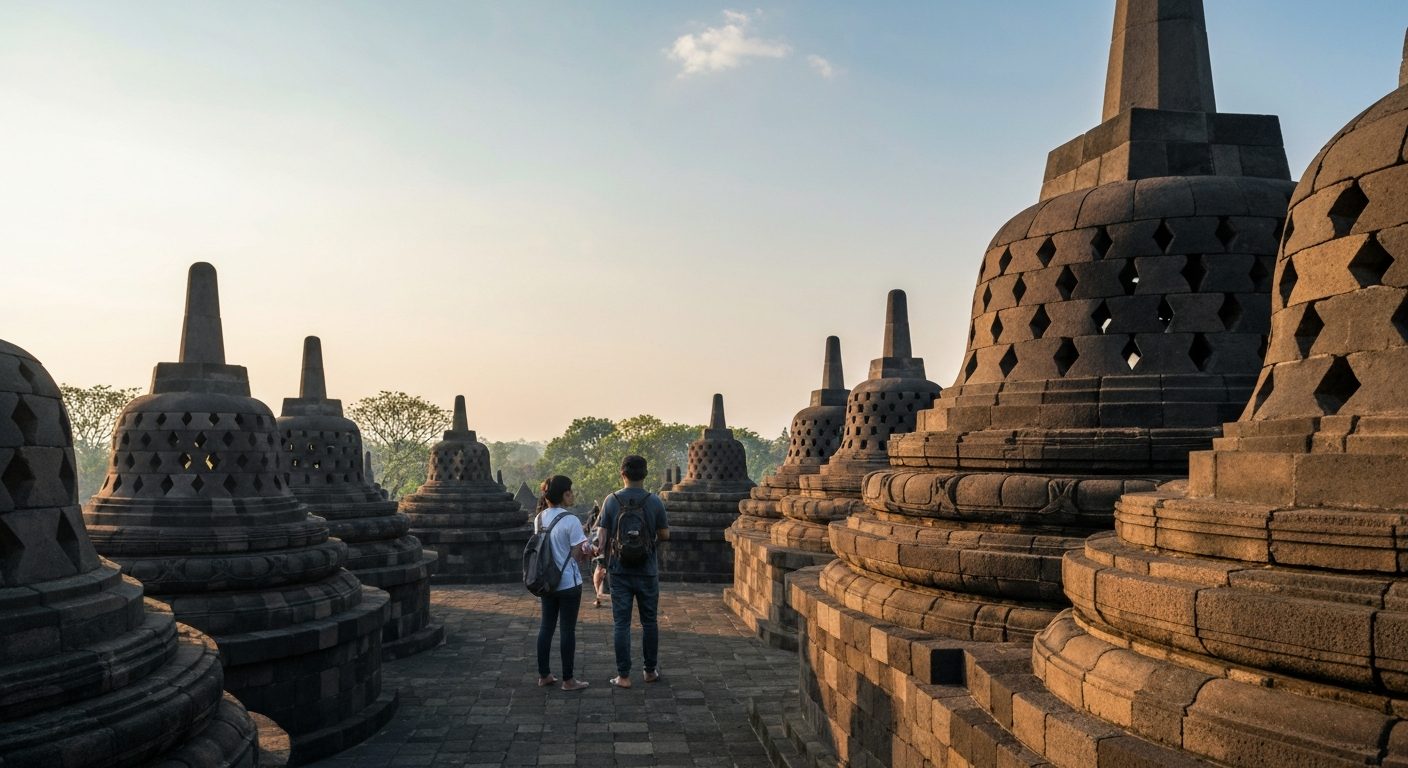
Navigating the Borobudur dress code and understanding what to wear for your visit is straightforward once you know the core requirements. Primarily, the Borobudur dress code requires covering your shoulders and knees as a sign of respect for this sacred Buddhist monument.
As a Temple Heritage & Etiquette Researcher, my role is to help you prepare for a meaningful and respectful experience at Borobudur. This guide translates the site’s cultural expectations and practical considerations into clear advice, ensuring you pack appropriately and understand the broader temple etiquette.
The Core Borobudur Dress Code: Modesty Rules
Borobudur is not just an ancient structure; it is an active place of worship and a profound symbol of Buddhist faith. Respect for its sacred nature begins with how we dress. The fundamental requirement for the Borobudur dress code is modesty: you must ensure your shoulders and knees are covered.
This is a non-negotiable expectation for all visitors, regardless of age or gender. Site management enforces these rules at the entrance, and visitors who do not meet the requirements may be asked to cover up before being permitted to enter the monument complex.
Covering Shoulders and Upper Arms
When planning what to wear at Borobudur Temple, think of modesty for your upper body. Sleeveless tops, tank tops, spaghetti straps, and even short-sleeved shirts that expose too much shoulder are generally not acceptable. Opt for clothing that covers your shoulders and upper arms completely.
Good choices include:
- T-shirts with standard short sleeves.
- Blouses or shirts with three-quarter or long sleeves.
- Light jackets or cardigans worn over a more revealing top.
- Shawls or scarves draped over the shoulders (though a full-coverage top is more secure and comfortable for climbing).
The goal is respectful coverage. Even if a sleeveless top feels comfortable in the tropical heat, consider the cultural context.
Covering Knees and Legs
Similarly, your lower body must also be covered to the knees or below. This means avoiding shorts, mini-skirts, or any clothing that leaves your knees exposed.
Suitable attire for your lower body includes:
- Long trousers or pants (jeans, linen pants, cargo pants).
- Maxi skirts or dresses that reach at least below the knee.
- Capri pants that extend past the knee.
For those who arrive with exposed knees, the site management typically provides a sarong. This brings us to a common point of confusion for visitors.
Understanding the Borobudur Sarong Requirement
Many visitors hear about a “Borobudur sarong requirement” and wonder if they need to bring their own or if it’s mandatory for everyone. Here’s the breakdown:
The sarong is primarily provided as a solution for those who arrive without adequate knee coverage. If your shorts or skirt are above the knee, you will be given a sarong at the entrance to wrap around your waist, ensuring compliance with the dress code. This is usually included in your entry ticket or provided free of charge, though practices can change, so it’s always wise to confirm with your operator.
If you are already wearing long pants, a maxi skirt, or a dress that covers your knees, you will generally not be required to wear an additional sarong. However, some tour packages or specific entrance gates (especially for sunrise tours) might include a sarong as part of the visitor experience, regardless of your attire, to maintain a uniform appearance or simply as a token. This is more of a cultural gesture than a strict dress code enforcement if you’re already covered.
Practicalities of the Provided Sarong
- Where you get it: Typically at the main entrance or at the designated climbing gate.
- How to wear it: It’s a simple wrap-around. Staff are usually on hand to demonstrate or assist if needed.
- Returning it: You’ll usually return it at the exit point for the monument area.
- Comfort: While functional, the provided sarongs are generally basic cotton. Bringing your own lightweight, breathable long pants or a skirt can offer more comfort and freedom of movement for climbing stairs.
While the provided sarong is helpful, planning your outfit to meet the modesty requirements from the start is the most comfortable and hassle-free approach.
Footwear for Your Borobudur Climb
The journey through Borobudur involves ascending multiple terraces and walking on ancient stone pathways. Choosing the right footwear is crucial for comfort, safety, and respect.
The Stone Climb: What to Expect
Borobudur is constructed primarily from volcanic stone. The pathways and stairs, while well-maintained, can be uneven, slippery when wet, and exposed to the elements. There are nine platforms, each with its own set of stairs, leading up to the main stupa. These stairs can be steep in places.
What to wear at Borobudur Temple on your feet should prioritize stability and comfort.
Recommended Footwear
- Comfortable Walking Shoes: Sneakers, sports shoes, or sturdy sandals with good arch support are ideal. They offer grip and protect your feet from the rough surfaces.
- Closed-Toe Shoes: These are preferable as they protect your toes from accidental bumps on the stone or if someone steps on your foot.
- Flat Soles: Avoid high heels, wedges, or shoes with slippery soles. These can be dangerous on the uneven stone steps.
- Broken-in Footwear: Don’t wear brand-new shoes that might cause blisters.
While you won’t be required to remove your shoes at Borobudur, opting for footwear that is easy to take on and off might be beneficial if you plan to visit smaller local temples or homes in the surrounding villages of Mendut or Candirejo, where shoe removal is common.
Footwear Comparison for Borobudur
- Recommended
-
- Sneakers/Walking Shoes: Excellent grip, comfort, and foot protection for uneven stone surfaces and climbing stairs.
- Sturdy Sandals (with back strap): Good for hot weather, but ensure they have good grip and support.
- Not Recommended
-
- High Heels/Wedges: Unsafe on uneven steps, risk of slipping and injury.
- Flip-flops/Sliders: Offer minimal support and grip, can easily slip off or cause tripping.
- Brand New Shoes: Risk of blisters and discomfort during extended walking.
Borobudur Sunrise What to Wear: Layering for Comfort
Many visitors choose the iconic Borobudur sunrise tour, a truly magical experience. However, the early morning hours bring specific considerations for Borobudur sunrise what to wear.
The temperature difference between pre-dawn and mid-morning can be significant.
Pre-Dawn Chill
Before the sun rises, especially during the dry season (roughly May to September), the air can be surprisingly cool, even chilly, on the open terraces of Borobudur. You’ll likely be waiting in the dark for a period before the sun appears.
For this reason, layering is key.
Recommended Layers for Sunrise
- Base Layer: Your standard modest clothing (long pants/skirt, covered shoulders).
- Mid-Layer: A light jacket, a hoodie, or a warm shawl. This can be easily removed once the sun is up.
- Warm Accessories (Optional but Recommended): A light scarf can protect your neck from the early morning chill, and if you’re particularly sensitive to cold, thin gloves might be appreciated while waiting.
Once the Sun Rises
As the sun ascends, the temperature will quickly rise, and by late morning, it can become quite warm and humid. Having layers you can easily shed and carry is essential. A small, lightweight backpack is perfect for stowing away jackets or sweaters.
Additional Sunrise Considerations
- Rain Protection: Even outside the main rainy season, tropical showers can occur. A lightweight, packable rain jacket or a small umbrella can be invaluable.
- Head Covering: A hat or cap can provide sun protection once the sun is fully out.
- Sunscreen: Don’t forget to apply sunscreen even if it’s cloudy; UV radiation can be strong.
Planning for varying temperatures will ensure your Borobudur sunrise experience is as comfortable as it is memorable.
Beyond Clothing: Borobudur Temple Etiquette and Cultural Rules
While the Borobudur dress code is important, it’s part of a broader set of behaviors that ensure a respectful visit to this UNESCO World Heritage site. Borobudur is a sacred place, and understanding its cultural rules enhances your experience and helps preserve the monument for future generations.
Quiet Conduct and Respectful Interaction
Borobudur is a place of pilgrimage and meditation. Maintaining a quiet and contemplative atmosphere is paramount.
- Keep voices low: Speak softly, especially when near other visitors or areas where people may be meditating.
- No loud music or noise: Avoid playing music from portable speakers or making excessive noise.
- Respect private moments: Be mindful of individuals or groups engaged in prayer or meditation. Give them space.
- Mind your children: Ensure children are supervised and encouraged to also maintain respectful behavior.
Your presence at Borobudur should contribute to its serene ambiance, not detract from it.
No Touching: Protecting Ancient Reliefs and Stupas
The intricate stone carvings (reliefs) that adorn Borobudur’s terraces tell stories of Buddhist cosmology and the life of Buddha. The 72 bell-shaped stupas, each housing a statue of Buddha, are iconic. These elements are thousands of years old and incredibly fragile.
- Do not touch the reliefs: Oils from skin, even clean hands, can degrade the stone over time. Observe them with your eyes, not your hands.
- Do not touch or climb on stupas: These are sacred structures. Climbing on them or touching the Buddha statues inside is highly disrespectful and can cause damage.
- Stay on designated pathways: Do not wander off marked routes, as this can damage unseen parts of the monument or lead to unsafe areas.
These rules are in place to preserve a global treasure. Each visitor’s cooperation is vital.
Photography Norms and Drone Use
Borobudur is incredibly photogenic, and capturing its beauty is a natural desire. However, certain guidelines apply.
- Be considerate: When taking photos, be mindful of other visitors. Avoid blocking pathways or monopolizing views for extended periods.
- No tripods or large photography equipment without permission: For professional-grade equipment or tripods, you often need special permits from site management.
- No drones without explicit permission: Drone use is strictly controlled and almost always requires specific permits from the Indonesian authorities and site management. Flying a drone without permission can lead to confiscation and penalties.
- No commercial photography/videography without permits: If you intend to use your photos or videos for commercial purposes, secure the necessary permits in advance.
- Selfie sticks: Generally permitted, but use them cautiously and ensure they don’t interfere with others’ experiences or risk damaging the monument.
Always prioritize respect for the site and other visitors over getting the perfect shot.
Food, Drink, and Waste
To maintain the cleanliness and integrity of Borobudur, rules regarding food and drink are in place.
- No eating or drinking on the monument: Consume food and beverages in designated areas outside the monument structure itself.
- Carry out your waste: “Leave no trace” is a universal principle for heritage sites. Dispose of all your rubbish responsibly in bins provided, or take it with you. Do not litter.
- No smoking: Smoking is strictly prohibited within the monument complex.
Respecting Local Communities
Your visit to Borobudur often extends to the surrounding areas, including the charming villages of Mendut and Candirejo, and the Mendut Temple itself. These communities are an integral part of the Borobudur experience.
- Support local artisans fairly: If purchasing souvenirs, engage respectfully with vendors.
- Be mindful in villages: When visiting local villages, dress modestly and ask permission before taking photos of people or private property.
- Learn a few basic Bahasa Indonesia phrases: “Terima kasih” (thank you) goes a long way.
- Mendut Temple: If you visit Mendut Temple, another important Buddhist site nearby, similar dress code and etiquette rules apply. You will need to cover your shoulders and knees. Mendut Temple is an active monastery, so observe a quiet demeanor.
By extending courtesy and respect to the local people and their customs, you enrich your own journey.
Preparing for Your Borobudur Tour: A Checklist
To help you plan your Borobudur tour from Bali or Yogyakarta, here’s a practical checklist combining dress code requirements and essential items.
Clothing Checklist:
- Tops: Long-sleeved or T-shirts that cover shoulders and upper arms.
- Bottoms: Long pants (trousers, jeans) or maxi skirts/dresses that cover knees.
- Outerwear (for Sunrise Tours): Light jacket, hoodie, or warm shawl for early mornings.
- Sarong: (Optional) If you prefer to bring your own, otherwise one will be provided if needed.
Footwear Checklist:
- Comfortable Walking Shoes: Sneakers, sturdy sandals with good grip.
- Socks: If wearing closed-toe shoes.
Other Essentials:
- Small Backpack: For water, snacks, layers, and personal items.
- Water Bottle: Stay hydrated, especially during the day.
- Sun Protection: Hat/cap, sunglasses, and sunscreen.
- Rain Protection: Lightweight rain jacket or small umbrella (especially during rainy season: roughly October to April).
- Insect Repellent: Useful, particularly if visiting surrounding green areas.
- Camera: (With respect for photography rules).
- Cash (IDR): For small purchases, souvenirs, or local snacks.
- Copy of Passport/ID: For identification purposes (keep original secure).
- Your Borobudur Entry Ticket/Voucher: Ensure you have this ready.
Remember that while Borobudur Tour From Bali, operated by Bali Premium Trip, arranges your transport and licensed on-ground guides, you are responsible for your personal belongings and adherence to site rules. Confirm any specific requirements with our team before your travel date, as temple regulations can be updated.
We understand that planning an international trip involves many details. Our team at Borobudur Tour From Bali, run by Bali Premium Trip, is here to simplify your journey. We are transparent about the logistics and what our licensed local partners manage on the ground, ensuring you have clear expectations.
Plan your trip to Borobudur with us today. Our team is available via WhatsApp to answer your questions and help tailor your perfect itinerary.
Frequently Asked Questions About Borobudur Dress Code & Etiquette
Do I need to bring my own sarong for Borobudur?
You do not strictly need to bring your own sarong if your clothing already covers your shoulders and knees. If your knees are exposed (e.g., if you are wearing shorts or a short skirt), the temple management will provide a sarong for you at the entrance, usually included in your ticket. However, some visitors prefer to bring their own for personal comfort or style.
Can I wear shorts at Borobudur?
No, you cannot wear shorts at Borobudur if they expose your knees. The Borobudur dress code requires visitors to cover their knees as a sign of respect. If you arrive in shorts, you will be provided with a sarong to wrap around your waist to ensure proper coverage before you are allowed to enter the monument area.
What kind of shoes are best for climbing Borobudur?
The best shoes for climbing Borobudur are comfortable, closed-toe walking shoes like sneakers or sturdy sandals with good grip. The monument involves climbing many stone steps, which can be uneven or slippery when wet. Avoid high heels, wedges, or flip-flops, as they offer poor support and can be unsafe.
Are there any specific rules for photography at Borobudur?
Yes, photography at Borobudur should be respectful. Avoid touching the reliefs or stupas for photos, and be mindful of other visitors. Drone use and professional photography equipment (like large tripods) generally require special permits. Always prioritize the preservation of the site and the experience of others over capturing a specific shot.
Is there a different dress code for Borobudur sunrise tours?
The core dress code for Borobudur sunrise tours is the same: shoulders and knees must be covered. However, for sunrise, it’s highly recommended to wear layers. Early mornings can be cool or chilly on the open terraces, so bring a light jacket, hoodie, or shawl that you can easily remove as the sun rises and temperatures increase.