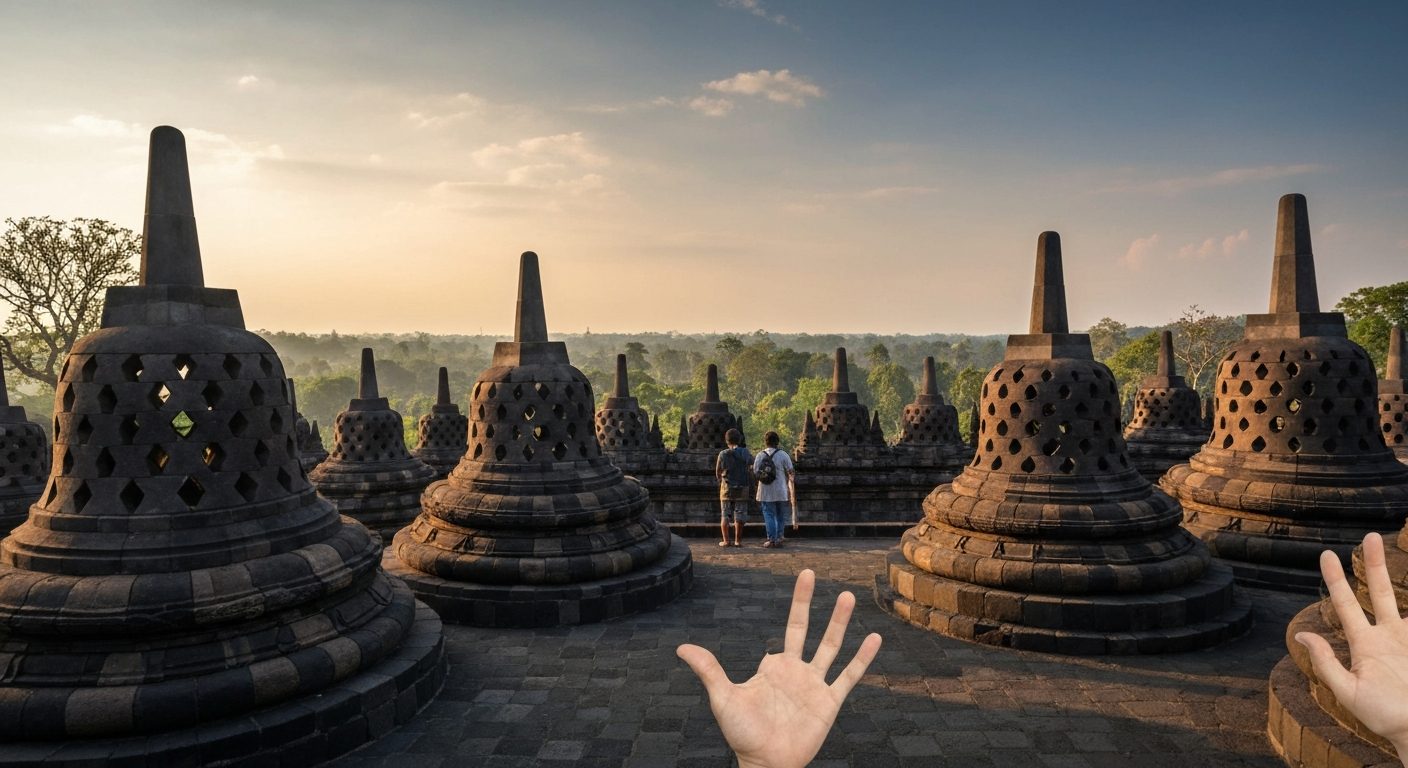
A borobudur tour for elderly or disabled visitors is absolutely possible, but it needs realistic expectations and careful pacing. This page explains how access really works, what help is available, and how we at Bali Premium Trip build the day around the least-mobile person in your group.
As Temple Heritage & Etiquette Researcher for Borobudur Tour From Bali, I spend a lot of time translating regulations and on-site realities into plain guidance. Borobudur is a 9th‑century stone monument, now in an active conservation phase. That means rough steps, limited handrails, and new rules about how and when visitors may climb the upper terraces.
This article is for families planning a private Borobudur tour from Bali or Yogyakarta with:
- Elderly parents or grandparents
- Pregnant travellers
- Children under 5
- Wheelchair users or anyone with limited mobility
I’ll be honest about what is easy, what is hard, and what no tour operator can change — so you can decide if Borobudur is right for your group, and in which format.
—
How accessible is Borobudur today?
From an accessibility perspective, think of Borobudur in three layers:
- Temple park & outer grounds – Relatively flat, paved paths; easier for wheelchairs and strollers.
- Temple base level (ground platform around the monument) – Gently sloping paths and some ramps, but with patches of uneven paving.
- Temple terraces (up the stairs into the relief galleries and stupas) – Steep, narrow stone steps with height limits and strict ticketing.
UNESCO and the temple management have tightened climbing rules to protect the stone. The general pattern (which can change seasonally and should be rechecked) is:
- You must buy a special “structure” ticket to climb the terraces, separate from the park/temple‑yard ticket.
- Visitor numbers and time slots are limited, partly for conservation, partly for safety.
- Certain age, footwear and health conditions may be discouraged or restricted for climbing.
- The stone surfaces can be hot, slippery when wet and uneven, even on the lower levels.
Bali Premium Trip does not control these rules. We arrange the tickets and licensed local guides according to the current system, and we advise you honestly if a full climb is appropriate for your slowest or most fragile traveller.
—
Key challenges for less-mobile visitors
1. Stairs and uneven stone
The central challenge for a borobudur tour accessibility wheelchair elderly visitor is the monument itself:
- Steps are high and shallow, with no modern handrails on most flights.
- The stone is unpolished and uneven, worn by centuries of use.
- Certain passages between stupas are narrow, which can feel unstable if your balance is weak.
If you or a family member already struggles with normal household stairs, climbing all terraces of Borobudur is unlikely to be safe or enjoyable. It is better to experience the temple from ground level with a knowledgeable guide than to push beyond comfort.
2. Heat, humidity and sun
Central Java can feel heavy and hot, especially for elderly or pregnant visitors:
- Midday temperatures commonly reach 30–33°C (86–91°F) with strong sun.
- Humidity is often over 70%, which makes any staircase climb more tiring.
- The stone radiates heat, especially late morning and early afternoon.
Dehydration and overheating are real risks, especially for seniors on a Borobudur sunrise tour that starts very early and disrupts sleep.
3. Distance and walking
From the vehicle parking area to the base of the monument, the walking distance varies depending on gate and drop-off, but you should assume:
- Around 500–800 metres of walking in total for a gentle circuit around the park and the base, not counting stair climbing.
- Some sections have gentle inclines and patches of rougher paving.
For most elderly guests who walk daily at home, this is manageable at a slow pace with rest breaks. For wheelchair users or those who rely on walkers, proper planning is important.
—
Wheelchair access and limited mobility: realistic options
Is there a borobudur wheelchair accessible tour?
There is no way to roll a standard wheelchair up the ancient stone terraces. That part of the structure is stairs only, and the conservation authority is strict.
However:
- The outer grounds and viewpoints offer clear, photogenic views of the monument.
- Some ramped or gently sloped paths approach the base of the temple.
- Benches and shaded areas are available in parts of the park for resting.
In practice, a borobudur wheelchair accessible tour means:
- Staying on the park paths and lower viewpoints
- Possibly reaching the base platform, depending on current entrance routes
- Skipping the steep internal galleries and upper stupas
Our planning team will ask about:
- Type of wheelchair (manual or powered)
- Whether you can stand or manage a few steps with assistance
- How much independent transfer you can do (e.g. from wheelchair to bench)
That way your guide can suggest the best routes and realistic viewpoints for your ability.
Is Borobudur stroller friendly?
Partly.
- Strollers are okay on much of the paved park area and some of the approach paths.
- They are not suitable on the stone steps or narrow upper galleries.
- Lifting a stroller up multiple steep flights is physically demanding and not recommended.
For babies and toddlers, a soft carrier or structured backpack carrier is usually safer and more flexible, especially if at least one adult in the group has both hands free and good balance.
—
Borobudur tour for elderly or disabled travellers: planning by risk and comfort
Every elder is different. An active 70‑year‑old who walks several kilometres daily is not the same as a 82‑year‑old with heart or knee problems. Here is how we think about a borobudur tour for elderly or disabled visitors.
Health and medical clearance
This page is for planning, not medical opinion. Anyone who is:
- Pregnant
- Living with heart conditions, uncontrolled blood pressure, or respiratory disease
- Recovering from recent surgery
- Prone to dizziness or balance issues
should discuss a Borobudur visit with their own doctor before flying to Indonesia. You know your body; your doctor knows your history. Your guide does not.
Pacing and rest breaks
On a private tour, our default is to build the day around the least-mobile person:
- Slow walking speed with frequent shade breaks
- Time to drink water, sit and simply enjoy the view
- Option to remain at a lower level while others climb a little higher
We advise families to be very clear in advance: if Grandpa cannot safely climb, the whole group can still enjoy the site by focusing on lower levels, stories, and nearby villages, instead of forcing a difficult ascent.
Private vehicle and proximity
From Yogyakarta city, Borobudur is usually about 60–90 minutes by private car, depending on traffic. From Semarang and other points it may be more. From Bali, you will first fly to Yogyakarta or Solo (typical flight time ~1 hour 10 minutes, plus airport transfers).
A private vehicle matters for elderly or disabled guests because:
- You control air-conditioning, music, and stops.
- You can leave extra water, snacks, medication, or spare clothes safely in the car.
- If anyone feels unwell, you can return immediately, not wait for a group schedule.
Bali Premium Trip arranges these vehicles with licensed local drivers; we do not mix strangers in your car unless you expressly book a shared arrangement.
—
Pregnant visitors: is a Borobudur tour safe?
A borobudur tour pregnant woman safe plan depends on stage of pregnancy, your usual activity level, and your doctor’s advice. Many pregnant women visit, but that does not mean every pregnancy should.
Key considerations for pregnancy
- Heat and dehydration – Plan for early morning or late afternoon, stay in the shade, drink regularly.
- Uneven steps – Your balance can change in pregnancy; a slip on stone can be serious.
- Toilet access – You may need more frequent bathroom stops than others.
- Travel fatigue – Early wake‑ups for sunrise and long drives can exhaust you.
Our practical, non-medical advice:
- Get written or clear verbal “yes” from your doctor for flying and light stair walking.
- Prefer gentle lower‑level visits: enjoy the base reliefs and park instead of aiming for the top.
- Consider skipping sunrise if very early starts leave you drained or nauseous; a daylight visit at a slower pace may be wiser.
Your guide can help you judge the steps on site. If at any point you don’t feel steady, staying on a bench with a view is the better choice.
—
Visiting Borobudur with children under 5
A borobudur tour with children under 5 can be beautiful and memorable, as long as expectations are adapted to toddler reality.
Attention span and heat tolerance
- Toddlers get hot fast, then cranky even faster.
- Under‑5s rarely want to listen to long explanations of Buddhist cosmology or 9th‑century Sailendra kings.
- They love: wide open spaces, stairs (for a short time), animals in the surrounding rice fields, and ice cream.
We encourage parents to:
- Let small children set the time limit for being on the stone. If they start to melt down, step away.
- Alternate between short story moments at relief panels and simple walking/playing breaks.
- Bring a hat, tube of sunscreen, and very regular water breaks.
Safety on steps and ledges
The upper levels have low parapets and open edges. There are no modern safety fences.
- Never let children run on the stone terraces.
- Always hold a toddler’s hand on stairs.
- Carriers are safer than trying to carry a wriggling child in arms down steep steps.
Many families find that one or two adults go slightly higher with older children, while another adult stays on a lower terrace or at ground level with younger siblings. Your guide helps coordinate meeting points and times.
—
Toilet facilities, food and rest areas
Borobudur toilet facilities for visitors
Most guests are surprised by how the toilets shape their day. Borobudur toilet facilities for visitors are:
- Available at the park entrance and in some commercial areas (souvenir zone, restaurants).
- Limited right near the monument itself. You cannot always find a toilet at short notice once you are on the structure.
- Generally squat‑style or mixed squat and seated, with varying accessibility and cleanliness.
Practical guidance:
- Use the bathroom before walking toward the temple.
- For elderly visitors or pregnant women, plan scheduled toilet stops as you move between parking, temple, and nearby sites like Mendut.
- Carry tissues and hand sanitiser; these are not always provided.
Your guide will always show you the nearest facilities before and after the temple visit.
Food, drinks and rest
- Bottled water is widely sold in and around the park, but carrying your own reusable bottle is more comfortable.
- Snack stalls and simple restaurants line the outer area; options right at the temple base are more limited.
- Benches and shaded spots exist but can be busy during peak hours and holidays.
If you have blood sugar concerns or travel with young children, keep simple snacks handy in your daypack.
—
Borobudur sunrise tour safety for seniors
Many families ask about a Borobudur sunrise tour safety for seniors. The sunrise slot has special magic: softer light, slightly cooler air, and fewer crowds early on. But it also has risks.
Pros for seniors
- Cooler temperatures compared to midday
- Lower UV exposure early in the morning
- More peaceful, less hectic atmosphere
Cons for seniors
- Very early wake‑ups (often 03:00–03:30 from Yogyakarta hotels)
- Moving on steps in low light before the sky brightens
- Increased risk of fatigue, especially for travellers with jet lag
For many older guests, a sunrise‑adjacent time works better: arriving early morning after sunrise, at around 07:00–08:00, when light is gentle but visibility is clear and your sleep is less disturbed.
If your parent already struggles with poor sleep or confusion in unfamiliar places, we strongly suggest prioritising a calm, well-rested daylight visit over the pressure of a sunrise climb.
—
What a private tour actually solves (and what it cannot)
A private, slow-paced borobudur tour for kids and families from Bali or Yogyakarta solves many comfort and logistics issues, but it does not change the physical nature of the monument.
A private tour CAN provide
- Door-to-door transfers with air‑conditioned private vehicles (capacity typically 2–12 guests per car or minibus).
- Flexible timing for rest stops, snack breaks and route choices.
- A licensed local guide focused only on your group’s pace, not a large crowd.
- Help with ticketing and time-slot coordination, including structure access if suitable.
- Suggestions for alternative activities (village walks, pottery, cycling with a support car) if climbing is not suitable.
A private tour CANNOT change
- The stairs, stone surfaces and conservation rules of Borobudur.
- The heat and humidity of the day.
- The distance between toilets and the monument.
- Any last-minute closures or policy changes announced by the temple authority for conservation or safety reasons.
Our promise as Bali Premium Trip: we will explain these limits up-front, not overpromise, and help you design a day that still feels special even if the whole group never stands on the top terrace.
—
Sample pacing: different groups, different plans
To make this concrete, here is a comparison of how we might pace different groups.
| Group type | Likely temple access | Recommended time of day | Key adjustments |
|---|---|---|---|
| Active seniors (70s, walk daily) | Ground & 1–2 terraces, depending on on-site comfort | Early morning or late afternoon | Slow pace, many photo breaks, clear “stop anytime” agreement |
| Seniors with heart / joint issues | Ground level and park viewpoints only | Early morning after sunrise | Shaded rest spots, minimal stairs, short total walking distance |
| Pregnant visitor (doctor-approved) | Ground & possibly one low terrace | Morning, avoiding midday heat | Frequent water and toilet breaks, optional non-climb plan |
| Family with kids under 5 | Ground & a few terraces, time-limited by child mood | Early morning or late afternoon | Carrier instead of stroller on stone, short “story bursts” |
| Wheelchair user with limited transfer | Park and base viewpoints | Coolest daylight hours available | Route planning around ramps, benches and toilets |
Every real itinerary is then personalised based on your health, interests and how much time you have starting from Bali or Yogyakarta.
—
Indicative costs and trip structure
Pricing always depends on season, group size, and exact services. As of last verified June 2026, you can use these very general ranges:
- One-day private Borobudur tour from Yogyakarta (vehicle + driver + licensed guide + standard entrance tickets; structure tickets and meals extra): around US$120–250 per group of 2–6, depending on inclusions.
- Fly-in day or overnight trip from Bali (return flights + Yogyakarta transfers + private tour + guiding): commonly US$280–550 per person for simple hotel standards and daylight temple entry, rising upward with hotel class and extra activities.
These are not fixed quotes, just planning anchors. All bookings go directly through our own Bali Premium Trip reservations team, at transparent rates with no third‑party mark‑ups. On the ground, we arrange licensed local drivers, official guides, and park services on your behalf.
If you want a tailored estimate that accounts for a wheelchair user, elderly parent, or pregnancy needs, you can plan your trip with us detail by detail, including via WhatsApp for faster back‑and‑forth.
—
Respectful behaviour and dress code for all visitors
Accessibility planning goes together with respectful behaviour. For kids, elders and pregnant guests, the etiquette is the same — we just plan clothing and movement more carefully.
Dress code
Temple management and UNESCO recommend:
- Shoulders and knees covered – light cotton or linen works well in the heat.
- Avoid extremely tight or transparent clothes.
- Comfortable walking shoes or sandals with good grip.
If heat is a concern for older travellers or pregnant women, choose loose, breathable fabrics. You may also be offered or required to wear a sarong or cloth at the waist.
Behaviour on the monument
- Keep voices moderate; Borobudur is both a heritage site and a place of quiet reflection.
- No climbing on stupas or railings, even for photos.
- Teach children not to touch or lean on fragile carvings.
- Follow your guide’s cue on where sitting is allowed, especially for elderly guests needing frequent rest.
These guidelines are both cultural respect and physical safety.
—
How we plan your accessibility-focused Borobudur tour
When you contact our Bali Premium Trip team, the more detail you share, the better we can tailor your experience. Helpful information includes:
- Ages of all travellers
- Any mobility aids (wheelchair, cane, walker, stroller)
- Specific health conditions that affect walking, stairs, or heat tolerance (no need for medical records; general descriptions are enough)
- Doctor’s advice in broad terms (e.g. “okay to fly and walk short distances, no long climbing”)
We then:
- Suggest the best time of day for your group’s comfort.
- Propose a temple visit format (ground-focused, partial terrace climb, or full climb for only some members).
- Add compatible nearby experiences: e.g. an easy village ride in Candirejo with a horse-cart instead of cycling, or a gentle Mendut temple stop with more seating.
- Plan backup options in case someone feels tired or unwell on the day.
If you’d like to start that conversation, you can plan your trip with us via email or WhatsApp; we answer honestly, not with pressure.
—
FAQs
Can a wheelchair go up Borobudur’s steps?
No. The ancient stone terraces are only accessible by stairs. Wheelchairs can be used in the park and around some lower viewpoints, but not on the main staircases or upper levels.
Is it safe for an 80-year-old to climb Borobudur?
It depends on their health, balance and usual activity level. Many 80-year-olds enjoy the monument from the ground only. Anyone with heart, balance or joint issues should focus on lower viewpoints and consult their doctor before attempting the stairs.
Are there enough toilets for pregnant women or kids?
There are toilets at the entrance and in commercial areas, but fewer close to the monument itself. Pregnant visitors and families with small children should use bathrooms before walking to the temple and plan for regular stops as they move around the park.
Is a sunrise Borobudur tour too hard for seniors?
For some seniors, the cool air and quieter atmosphere work well. For others, the very early start and low light on the steps make it harder and less safe. A calm morning visit after sunrise is often a better balance of comfort and experience.
Can I visit Borobudur if I’m pregnant?
Many pregnant women visit Borobudur, but you should get your doctor’s approval first. With medical clearance, a slow, lower-level visit in the cooler hours, plenty of water, and flexible rest breaks can be planned safely with a private guide.